Last year I watched a 68-year-old woman from Portland get the best photo of the night at Xoxocotlán with nothing but an iPhone and a folding stool. She sat down at a single grave at 7:40 p.m., talked to the family for an hour, and shot by the light of eleven candles. Meanwhile a crew with two mirrorless bodies and a gimbal spent the same hour being pushed around the main aisle.
That’s the thesis of this article. For Día de los Muertos in Oaxaca (October 31 to November 2, 2026, with the big vigil on a Saturday night this year), the best event for an over-60 phone photographer isn’t the most famous one. It’s the one that matches your knees, your bedtime and your phone’s low-light limits. I scored four headline events on five criteria, and the results surprised me.
Key Takeaways
- Centro Histórico comparsas score highest (8.0/10) for over-60 phone photographers: zero transport, benches every 50 m, and peak action at a civilised 6-9 p.m.
- Panteón de Xoxocotlán has the best single photos of the four, but only if you arrive by 7 p.m. on October 31 and leave before the 10 p.m. tour-bus surge; a taxi from the Zócalo is MXN 180-250 (€9-12 / $10-13) in October 2026.
- The San Agustín Etla Muerteada runs from roughly 10 p.m. to sunrise, 20 km from town, with fireworks at head height: it ranks last (4.8/10) unless you have a driver booked for a midnight exit.
- Mercado Benito Juárez’s ofrendas and tapetes are the lowest-effort shoot: free, daylight, one block from the Zócalo, best 9-11 a.m. when light pours through the east entrance.
- A comfortable four-night trip (Oct 30-Nov 3, 2026) costs €634 per person at mid-range, €450-960 depending on hotel, excluding flights.
Key Numbers at a Glance (October 2026)
| Event | Distance from Zócalo | When it peaks | Getting there (one-way) | Ground / seating | Entry cost |
|---|---|---|---|---|---|
| Panteón de Xoxocotlán (Panteón Viejo + Nuevo) | 9 km south, 20-30 min | Oct 31, 7 p.m.-2 a.m.; families arrive from dusk | Taxi MXN 180-250 (€9-12); colectivo MXN 15 (€0.70) from Periférico; guided tour €35-60 | Dirt aisles, 15-25 cm step-ups, almost no benches | Free (small donation to families welcome) |
| San Agustín Etla Muerteada | 20 km north, 35-45 min | Nov 1, 10 p.m. to Nov 2, 7 a.m. | Taxi MXN 350-500 (€17-24); return after midnight MXN 600+ (€29+) | Cobbled streets, steep grades, standing only | Free |
| Mercado Benito Juárez tapetes & ofrendas | 1 block south of Zócalo | Oct 29-Nov 2, 8 a.m.-8 p.m. | Walk, 3 minutes | Flat concrete, café stools inside, toilets MXN 8 (€0.40) | Free |
| Centro Histórico comparsas (Alcalá, Santo Domingo, Jalatlaco) | 0-1.2 km | Oct 31-Nov 2, 5-10 p.m. | Walk | Flagstones, benches on Alcalá, Santo Domingo atrium steps | Free |
Exchange rate used: MXN 21 = €1 and €1 = $1.08, as of mid-October 2026. Round up if you’re reading this later.
How I Scored Them
I weighted five criteria for an over-60 photographer working with a current phone (iPhone 15 or newer, Pixel 8 or newer, Samsung S23 or newer). A 25-year-old with a Sony A7 would weight these very differently.
- Photo yield (30%): frame-worthy images per hour, given phone sensors and candlelight.
- Physical accessibility (25%): ground surface, step-ups, seating, toilets, distance from your bed.
- Timing and stamina (20%): does the good stuff happen before 10 p.m.?
- Crowd pressure (15%): can you hold a spot and steady your phone?
- Cost and logistics (10%): transport, tours, the return-trip problem.
| Event | Photo yield (30%) | Accessibility (25%) | Timing (20%) | Crowds (15%) | Cost (10%) | Weighted score | Rank |
|---|---|---|---|---|---|---|---|
| Centro Histórico comparsas | 8 | 9 | 8 | 5 | 10 | 8.0 | 1 |
| Mercado Benito Juárez | 5.5 | 9 | 10 | 7 | 10 | 7.95 | 2 |
| Panteón de Xoxocotlán | 10 | 6 | 6 | 4 | 7 | 7.0 | 3 |
| Etla Muerteada | 9 | 3 | 2 | 3 | 5 | 4.8 | 4 |
Read the table honestly: Xoxocotlán has the best ceiling of the four. It loses on the aisles, the hour and the crowds. If your knees are fine and you’re happy to be in bed at midnight, bump it to joint first.
1. Centro Histórico Comparsas: Best Overall for Over-60 Phone Shooters
What you’re photographing
Comparsas are neighbourhood parades: brass bands, stilt walkers, giant mojiganga puppets, dancers in full catrina paint. From October 31 to November 2 they roll down the Andador Macedonio Alcalá from Santo Domingo to the Zócalo, usually starting between 5 and 7 p.m. The Jalatlaco barrio comparsa (1.2 km northeast of the Zócalo, around Calle Hidalgo) is the most photogenic and starts around 7 p.m. on November 1.
Phones love this. There’s streetlight and shopfront light, the subjects move slowly and smile at cameras, and you shoot at face height from a seat.
The over-60 advantage
You don’t need to be in the parade. Sit on a bench outside the Museo Textil (Hidalgo 917) or on the Santo Domingo atrium steps 45 minutes before the start, and the comparsa comes to you. At Xoxocotlán, by contrast, you walk 400-600 m on dirt to find your composition. Toilets: Café Brújula on Alcalá (coffee MXN 55, €2.60) lets paying customers use theirs; the Zócalo’s public toilets cost MXN 8 (€0.40).
Phone settings that work here
- Use the 2x or 3x telephoto, not the wide. Faces at 2x from a bench look like portraits; at 1x they look like a crowd.
- Tap a painted face, then slide exposure down a third of a stop. Phones over-brighten catrina white.
- Shoot in burst as a band passes; one in eight frames will have the trumpet bell catching the light.
- Turn off Live Photos if storage is tight; a two-hour comparsa fills 4-6 GB otherwise.
The catch
Crowds. The Alcalá between Murguía and Morelos is shoulder-to-shoulder by 8 p.m. on October 31. Set up north of Santo Domingo at the Constitución corner, where the parade is still forming: the stilt walkers stretch, the band tunes, and the best candid frames happen before anyone pushes.
2. Mercado Benito Juárez Tapetes and Ofrendas: The Daylight Option
What’s there
Mercado Benito Juárez occupies the block bounded by Las Casas, 20 de Noviembre, Flores Magón and Miguel Cabrera, one block south of the Zócalo. From roughly October 29, stall holders build ofrendas with cempasúchil marigolds, pan de muerto, sugar skulls and photographs of the dead, and several aisles get sand-and-petal tapetes laid on the concrete. Stalls open around 7 a.m. and wind down by 8 p.m. The phone window is 9-11 a.m., when sun comes through the east entrance on Miguel Cabrera and side-lights the marigolds.
Why it ranks second despite a lower photo ceiling
It scored 10/10 on timing and 9/10 on accessibility. The floor is flat, you can sit at a juice stall (MXN 35, €1.70 for a large) while you edit, and you’re three minutes from your hotel bed. No night mode, no shaky hands, no 1 a.m. taxi negotiation. The photos are quieter: still lifes, vendor portraits, detail shots of bread and chocolate. Detail is where a phone beats the big cameras: get 30 cm from a sugar skull in macro mode and the colour saturation is absurd.
Combine it with the tapetes at Plaza de la Danza
The competitive sand tapetes (some 6 x 10 m) are laid at the Plaza de la Danza beside the Basílica de la Soledad, a 7-minute flat walk west along Independencia. Shoot from the plaza’s upper terrace steps for a top-down angle without climbing. Go after 5 p.m. on October 31 or November 1, when the tapetes are finished and backlit by sunset.
Skip the Mercado 20 de Noviembre next door for photos (smoke-filled and dim), but eat there: tasajo, chorizo and grilled onions from the Pasillo de Humo run MXN 150-180 (€7-9) for two.
3. Panteón de Xoxocotlán: Best Photos, Hardest Night
The two cemeteries
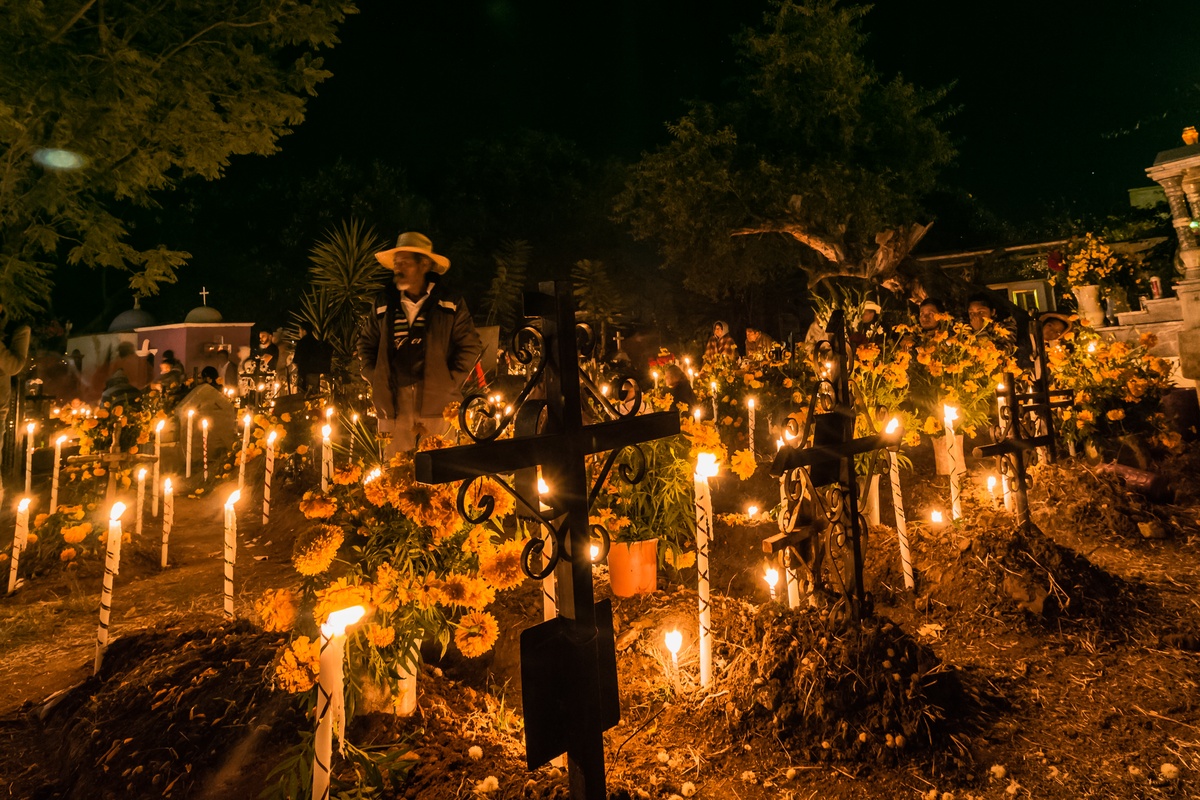
Santa Cruz Xoxocotlán sits 9 km south of the Centro, almost at the airport fence, with two cemeteries about 600 m apart. The Panteón Viejo is small, roofless, candle-lit and the one in every photo essay. The Panteón Nuevo is four times larger, has paved main avenues and far more families.
The vigil is the night of October 31 into November 1, 2026. Families arrive at dusk (around 6:30 p.m.), light candles, lay marigolds and settle in with mezcal and bands. Tour buses arrive from 9:30 p.m.; by 11 p.m. the Panteón Viejo has more visitors than graves.
Why it’s still worth it over 60, with conditions
Candlelight on a face at 1 m is the single best thing a modern phone’s night mode does. At Xoxo you’ll get a dozen frames you’d never get in the Centro. But the ground in the Panteón Viejo is packed dirt with 15-25 cm raised grave borders, invisible under the crowd after 9 p.m. Two people in my group last year turned an ankle there.
My recommendation: do the Panteón Nuevo, not the Viejo. The main avenue is paved, 4 m wide, the family scenes along it are identical in spirit, and you’ll be 50 m from a taxi at all times.
Logistics in numbers
| Option (Oct 31, 2026) | Cost per person | Door-to-door time | Pros | Cons |
|---|---|---|---|---|
| Street taxi from Zócalo, 6:30 p.m. | MXN 180-250 (€9-12) each way; agree the price first | 25 min out, 35-50 min back after 10 p.m. | Leave whenever you want | Return taxi after 9:30 p.m. means a 10-min walk to the main road |
| Hotel-arranged private driver, 4-hour wait | MXN 1,200-1,600 (€57-76) per car, split 2-4 ways | Same, but the car is where you left it | Zero stress, a seat to edit in | Book by Oct 25; hotels run out |
| Guided group tour (GetYourGuide / Viator / hotel desk) | €35-60 incl. transport, often a mezcal stop | Depart 8-9 p.m., return 1-2 a.m. | Cheapest “safe” option, guide explains etiquette | You arrive with the crowds and can’t leave early |
| Colectivo from Periférico / Xoxo stop | MXN 15 (€0.70) | 40 min plus walking | Local experience, nearly free | Standing, packed, no return after 10 p.m. |
Choose the private driver. For two people it’s €30-38 each, you arrive at 6:45 p.m. in blue-hour light, and you’re back at the hotel by 10:30 p.m. as the buses pull in.
Etiquette, which is also your photo strategy
- Ask before photographing a family. “¿Puedo tomar una foto?” with the phone visible works nine times out of ten. Being told no is fine.
- No flash, no LED torch pointed at graves. It’s rude and it kills the image anyway.
- Bring pan de muerto or a bag of candles (MXN 40-60, €2-3 at the Mercado de Abastos) to offer. You’ll be invited to sit, and sitting is how you get the photo.
- Stay 10-15 minutes per grave minimum. Phones need stillness; so do grieving families.
4. San Agustín Etla Muerteada: Spectacular, and Wrong for Most Readers
What it is
The muerteadas of the Etla valley are all-night processions where masked townspeople (devils, viudas, doctors, the dead) and brass bands go house to house, performing satirical skits, drinking mezcal and setting off fireworks. San Agustín Etla, 20 km north of Oaxaca, has the most famous one. It starts around 10 p.m. on November 1 and finishes after sunrise on November 2.
Photographically it’s a 9/10: masks lit by fireworks and bare bulbs, chaos, motion, sweat. It’s also a 2/10 on timing and a 3/10 on accessibility, and that’s being kind.
The specific problems for over-60s
- Nothing meaningful happens before 11 p.m.; the peak is 1-4 a.m.
- Streets are steep and cobbled; the crowd moves as a single unit, and you move with it or get left in the dark.
- Fireworks (cohetes) are hand-held and fired at head height. Hearing protection is not optional.
- Return transport: nothing you can count on. Taxis drift back to town by 1 a.m. and quote MXN 600-900 (€29-43) if you find one.
If you insist
Go for the opening only. Book a driver to leave the Centro at 9 p.m. (MXN 1,500-2,000, €71-95 for a 4-hour round trip with waiting), stand at the municipal plaza where the comparsa assembles at 10 p.m., shoot the masks under the streetlights for 90 minutes, and be in the car by 11:45 p.m. The plaza is flat with a low wall to lean on.
Better alternative for the same hit of masks: the Jalatlaco comparsa on November 1 at 7 p.m. Same genre, 1.2 km from your bed, done by 9:30.
Decision Framework: Choose This If…
- Choose the Centro comparsas if you want the most photos per hour of effort, you’re staying within 10 blocks of the Zócalo, and you’d rather sit than queue. This is the default for most readers.
- Choose Mercado Benito Juárez + Plaza de la Danza if your hands aren’t steady in low light, you prefer colour to drama, or your travel partner tires fast. Do it every morning; the altars change daily.
- Choose Xoxocotlán (Panteón Nuevo, 6:45-10 p.m., private driver) if you can walk 1 km on paved ground, you’ve practised night mode at home, and you’ll spend €30-38 on the car. Skip it if balance is a concern.
- Choose the Etla Muerteada if you have a driver, earplugs, a walking pole and a long nap scheduled for November 2. Otherwise, substitute Jalatlaco.
Most over-60 travellers I’ve guided do three of the four: market mornings, Centro evenings, and one Xoxo night. That’s the itinerary costed below.
Smartphone Setup for Candlelight (Tested October 2025, Updated 2026)
- Night mode on, capped at 3 seconds. iPhone and Pixel suggest 5-10 s handheld in a cemetery; over 3 s, a 65-year-old’s hands blur candle flames into blobs. Tap the night mode icon and drag the slider left.
- Lock focus and exposure on the brightest face, not the candles. Long-press the face. The candles blow out slightly; that’s fine, they’re the light source.
- Shoot RAW if you can (ProRAW on iPhone Pro, RAW toggle on Pixel and Samsung Expert RAW). You recover 1-2 stops of marigold orange in Lightroom Mobile’s free tier.
- Brace, don’t tripod. Tripods block aisles and families hate them. Elbows on a grave edge, or a €15 clamp-on bean bag on a tomb corner, gives tripod stability with no footprint.
- Screen brightness down to 30%. At full brightness your screen is the brightest thing in the cemetery and ruins everyone’s night vision.
Gear that actually matters
- Power bank, 10,000 mAh minimum (Anker Nano, about €25). Night mode and 12-14°C post-midnight temperatures drain 60-70% of a battery in three hours.
- Small folding stool (Helinox Zero or a €12 fishing stool from the Mercado de Abastos hardware aisle). The single most useful item on this list.
- Headlamp with a red mode, pointed at your feet only, for the walk out.
- Connectivity: an Airalo Mexico eSIM (5 GB / 30 days, about €14 in October 2026) lets you back up to iCloud or Google Photos overnight and call your driver from the cemetery gate. Telcel coverage at Xoxo and Etla is solid, but slow at the Panteón Viejo when 3,000 people upload at once, so queue uploads for the hotel.
Where to Stay and Eat for Minimum Walking
Stay within the rectangle bounded by Independencia, Reforma, Constitución and García Vigil; everything here except Xoxo and Etla is within 12 minutes’ walk. Rates for October 30-November 3, 2026 are 2-3x normal and the good places sold out by August; check remaining hotels in Oaxaca for cancellations, which do appear in the final two weeks.
- Quinta Real Oaxaca (5 de Mayo 300): 16th-century convent, lift access, courtyard benches. €280-340/night over the festival, three minutes from Santo Domingo.
- Hotel Casa Antigua (Morelos 601): ground-floor rooms on request, rooftop for skyline shots. €150-190/night.
- Parador San Miguel (Independencia 503): a block from the Mercado Benito Juárez, €120-160/night; ask for a room away from the street, as comparsas pass at 11 p.m.
Eat early and sit down. Las Quince Letras (Abasolo 300) does mole negro for MXN 260 (€12) from 1 p.m.; go at 1:30 and you’ll shoot the 7 p.m. comparsa with energy. Boulenc (Porfirio Díaz 207) for 8 a.m. coffee and pan de muerto (MXN 45, €2) before the market. After Xoxo, Tlayudas Libres (Libres 212) serves until 3 a.m.; a tlayuda is MXN 120-150 (€6-7). Skip Casa Oaxaca’s €90 tasting menu during the festival: it runs 2.5 hours and you’ll miss the parade.
Costed Sample Plan: Four Nights, October 30 to November 3, 2026
Per person, two sharing, mid-range, excluding flights. Oaxaca (OAX) airport is 8 km from the Centro; the authorised shared shuttle is MXN 150 (€7) per person, a private airport taxi MXN 450 (€21) per car.
| Item | Detail | Cost per person (EUR, Oct 2026) |
|---|---|---|
| Hotel, 4 nights | Casa Antigua or similar, €170/night shared | €340 |
| Airport transfers | Shared shuttle in, private taxi out | €17 |
| Oct 30: Mercado de Abastos flower market + Benito Juárez altars | Walk; taxi back from Abastos MXN 80 (€4) with flowers | €4 |
| Oct 31: Benito Juárez morning, Plaza de la Danza tapetes 5 p.m., Xoxocotlán 6:45-10 p.m. | Private driver MXN 1,400 split two ways + candles to offer | €36 |
| Nov 1: Centro comparsas on Alcalá 5-8 p.m. or Jalatlaco 7 p.m. | Walk; a mezcal at Mezcaloteca MXN 120 (€6) while you wait | €6 |
| Nov 2: Panteón General (city cemetery, Calzada del Panteón) daytime, flat and paved | Taxi MXN 70 each way | €7 |
| Food, 4 days | Market breakfasts, one sit-down comida, tlayudas | €140 |
| eSIM + power bank | Airalo 5 GB + Anker 10k | €39 |
| Folding stool, headlamp | Bought at Abastos / brought from home | €15 |
| Contingency / tips to families and bands | Small notes, MXN 20-50 at a time | €30 |
| Total | €634 (about $685) |
Swap Casa Antigua for the Quinta Real and the total rises to about €960. Swap it for a well-reviewed guesthouse at €80/night and you’re near €450. Adding the Etla Muerteada with a driver costs €40-50 per person and most of November 2.
Buy flexible fares. Mexico City connections to OAX are famously overbooked around November 1, and if an airline bumps or cancels you, EU-departing passengers can claim under EC 261 through AirHelp, which takes a cut only if it wins.
Common Mistakes (I’ve Made Four of These)
- Arriving at Xoxocotlán with the tour buses. At 9:30 p.m. you’re photographing other photographers. 6:45 p.m. is the whole secret.
- Choosing the Panteón Viejo for the “iconic” shot. It’s 40 x 60 m. The Panteón Nuevo has the same candles, paved paths, and room to sit.
- Shooting at 1x wide from standing height. Sit, use 2x, get within 1.5 m.
- Letting night mode run 5-10 seconds handheld. Cap it at 3 s or brace.
- Booking a hotel outside the Centro to save money. You’ll spend the difference on surge-priced taxis and lose the 8:30 p.m. rest before the late comparsa.
- Using flash or an LED torch in the cemetery. You will be asked to leave, and you should be.
- Doing the Etla Muerteada on your first or last night. If you must, do it mid-trip with a free day after.
- Forgetting the altitude. Oaxaca sits at 1,555 m. Walk slower than you think on day one and drink more water than you want.
Verdict
For a smartphone photographer over 60, the Centro Histórico comparsas win: the highest return per step walked, no transport, and all the action before bedtime. Pair them with daily mornings at Mercado Benito Juárez and one carefully timed evening at Xoxocotlán’s Panteón Nuevo with a private driver, and you’ll come home with a better set than most people hauling 6 kg of glass.
Leave the Etla Muerteada to the 30-year-olds, or go for the first 90 minutes and own the fact that you left. The ranking method is the same one we used for comparing Japan’s castles for October family trips: score what matters to you, not what’s famous. If you’re going this year, book the driver for October 31 this week, charge the power bank, and practise night mode on a candle at your kitchen table tonight.
Frequently Asked Questions
What are the exact dates of Día de los Muertos in Oaxaca in 2026?
The core days are October 31 (Saturday), November 1 (Sunday) and November 2 (Monday), 2026. The Xoxocotlán cemetery vigil is the night of October 31, the San Agustín Etla Muerteada runs the night of November 1 into November 2, and Centro comparsas happen every evening from October 31 to November 2, with market altars up from around October 29.
How much does a taxi from Oaxaca Centro to Xoxocotlán cost?
A street taxi from the Zócalo to the Xoxocotlán cemeteries costs MXN 180-250 (€9-12 / $10-13) one way in October 2026, agreed before you get in. A private driver who waits four hours and brings you back runs MXN 1,200-1,600 (€57-76) per car, which for two people is cheaper and far less stressful than finding a return taxi after 10 p.m.
Is Xoxocotlán cemetery accessible for people with limited mobility?
The Panteón Viejo is not: packed dirt, raised grave borders of 15-25 cm, no benches, and dense crowds after 9 p.m. The Panteón Nuevo, 600 m away, has a paved 4 m main avenue and is manageable with a walking pole and a folding stool if you arrive before 7 p.m. Neither has accessible toilets, so use the hotel before you leave.
Can you take good Día de los Muertos photos with just a phone?
Yes. In candlelight a current iPhone, Pixel or Samsung often beats a DSLR handheld because of computational night mode. Cap night mode at 3 seconds, brace your elbows, use the 2x lens from within 1.5 m, lock exposure on a face rather than the candles, and never use flash. Shooting RAW and editing in the free Lightroom Mobile app recovers the marigold orange that JPEG flattens.
Is the Etla Muerteada worth it for older travellers?
Only with conditions: a pre-booked driver (MXN 1,500-2,000, €71-95 for the round trip with waiting), earplugs for the head-height fireworks, and a plan to leave by midnight. The spectacle peaks between 1 and 4 a.m. on steep cobbled streets, 20 km from Oaxaca, with no reliable return transport. The Jalatlaco comparsa on November 1 at 7 p.m. delivers similar masked costumes 1.2 km from the Zócalo and is the better choice for most over-60s.

About the Author: Tomáš Bzirský
Founder and editor of Distratech. Based in the Czech Republic, travelling regularly from Central Europe. Writes practical travel guides and travel-tech comparisons (eSIM, apps, airports) in six languages.