Every November the same question lands in my inbox: “I want to work remotely somewhere warm from January to March, I don’t want to fly 12 hours to Asia, and I’m tired of guessing which island actually has sun.” I’ve spent chunks of three winters across the Canaries and Madeira with a laptop, and the honest answer is that the four obvious candidates are far less interchangeable than the brochures suggest. One gets roughly twice the rain of the others. One gets sand-blasted by Saharan dust several times a winter. One has the best coworking scene by a mile but the cloudiest capital.
This guide puts the real numbers side by side: monthly sunshine hours, rain days, calima dust frequency, daytime highs and sea temperatures for January, February and March, plus what a month actually costs in each place in early 2027. Flight sales for the Jan–March period typically drop around Black Friday, so this is the week to decide.
Key Takeaways
- Lanzarote and Tenerife South are the sunniest (6.5–7.5 hrs/day Jan–Mar) with only 2–4 rain days a month; Funchal averages 5–6 hrs/day and 8–9 rain days.
- Calima (Saharan dust) hits Lanzarote hardest (typically 4–6 episodes a winter), Tenerife and Gran Canaria 2–4 times, and Funchal almost never.
- Sea temperature is a dead heat: 18–20°C everywhere, bottoming out in late February–March, so pack a 3/2 wetsuit if you plan to swim daily.
- A realistic solo month (1-bed Airbnb, coworking desk, groceries, some eating out) runs €1,900–2,300 in Tenerife South vs €1,500–1,900 in Las Palmas or Funchal in February 2027.
- Las Palmas de Gran Canaria has the deepest coworking/coliving scene; Funchal is the cheapest and greenest but needs the rain tolerance of a Brit.
Key Numbers at a Glance (January–March Averages)
These are 30-year climatological averages from AEMET (Spain) and IPMA (Portugal) for the main airport and coastal stations, rounded to what matters. Jan–Mar figures are averaged across the three months; the month-by-month breakdown follows below.
| Base | Sunshine (hrs/day) | Rain days / month | Rainfall / month | Daytime high | Sea temp | Calima episodes per winter | Wind |
|---|---|---|---|---|---|---|---|
| Tenerife South (Los Cristianos / El Médano) | 6.8 | 2–3 | 15–25 mm | 21–23°C | 19–20°C | 2–4 | Moderate (strong at El Médano) |
| Gran Canaria (Las Palmas) | 6.2 | 3–5 | 20–35 mm | 21–22°C | 19–20°C | 2–4 | Moderate |
| Lanzarote (Arrecife / Puerto del Carmen) | 7.0 | 2–4 | 10–20 mm | 21–23°C | 18–19°C | 4–6 | Strong (trade winds) |
| Funchal (Madeira) | 5.4 | 8–9 | 65–100 mm | 19–20°C | 18–19°C | 0–1 | Light in town, gusty at airport |
Read that calima column twice. It’s the variable nobody puts in the Instagram caption, and it’s the one most likely to wreck a work week.
Month-by-Month: January vs February vs March
The winter isn’t flat. January is the wettest and coolest across all four, March is noticeably sunnier and a degree or two warmer, and February carries the highest calima risk: the worst historical events, including the one that shut every Canary airport on 22–24 February 2020, cluster in February and March.
| Base | Jan: sun / rain days / high / sea | Feb: sun / rain days / high / sea | Mar: sun / rain days / high / sea |
|---|---|---|---|
| Tenerife South | 6.3 h / 3 / 21°C / 20°C | 6.8 h / 3 / 22°C / 19°C | 7.4 h / 2 / 23°C / 19°C |
| Gran Canaria (Las Palmas) | 5.7 h / 5 / 21°C / 20°C | 6.2 h / 4 / 21°C / 19°C | 6.8 h / 3 / 22°C / 19°C |
| Lanzarote (Arrecife) | 6.4 h / 4 / 21°C / 19°C | 7.0 h / 3 / 22°C / 19°C | 7.6 h / 2 / 23°C / 18°C |
| Funchal | 5.0 h / 9 / 19°C / 19°C | 5.3 h / 8 / 19°C / 18°C | 5.9 h / 8 / 20°C / 18°C |
Two caveats change the picture. First, Gran Canaria’s south coast (Maspalomas, Playa del Inglés) gets roughly one extra hour of sun per day versus Las Palmas and half the rain days, but the nomad infrastructure is almost entirely in Las Palmas. Second, Madeira’s southwest (Ponta do Sol, Calheta) is drier and sunnier than Funchal itself by a meaningful margin: roughly 6 hrs/day and 5–6 rain days in February instead of 8.
Sea temperature barely separates them. If you want to swim without a wetsuit every day in February, none of these is the Caribbean; 18–19°C is “fine once you’re in” for most people and “absolutely not” for others.
Calima: The Dust Factor Nobody Prices In
Calima is a Saharan dust intrusion carried on easterly winds. It turns the sky beige, drops visibility below 1 km in bad episodes, pushes temperatures up 5–8°C, and triggers AEMET air-quality warnings. Typical episodes last 2–4 days and hit 2–6 times between December and March.
Lanzarote and Fuerteventura, 100–130 km from the African coast, get the heaviest and most frequent events. Tenerife South and Gran Canaria get them too, but the dust has had time to thin. Madeira, 700 km further northwest, sees a weak calima maybe once a winter and often none at all.
For a remote worker the practical costs are: outdoor terraces become unusable, anyone with asthma or allergies suffers, and in extreme cases flights are cancelled. A calima closure counts as weather, so EU261 compensation won’t apply, but if an airline then cancels your rebooked flight for its own reasons, AirHelp is worth running the claim through.
- Track it: the free AEMET app (Spain) and IPMA (Portugal) issue 48-hour dust warnings; Windy.com’s “Dust mass” layer shows plumes coming off the Sahara a day or two out.
- Air quality: IQAir shows live PM10 readings; anything over 150 µg/m³ means close the windows and work indoors.
- Book flexible: for Lanzarote especially, pay the extra €10–15 for a Ryanair “Flexi Plus” or easyJet “Flexi” fare on both legs in February.
- Pack: saline nasal spray and a cheap HEPA desk purifier (Levoit Core Mini, around €45 on Amazon.es) make a 3-day episode tolerable.
Tenerife South: Most Sun, Most Tourists, Highest Rent
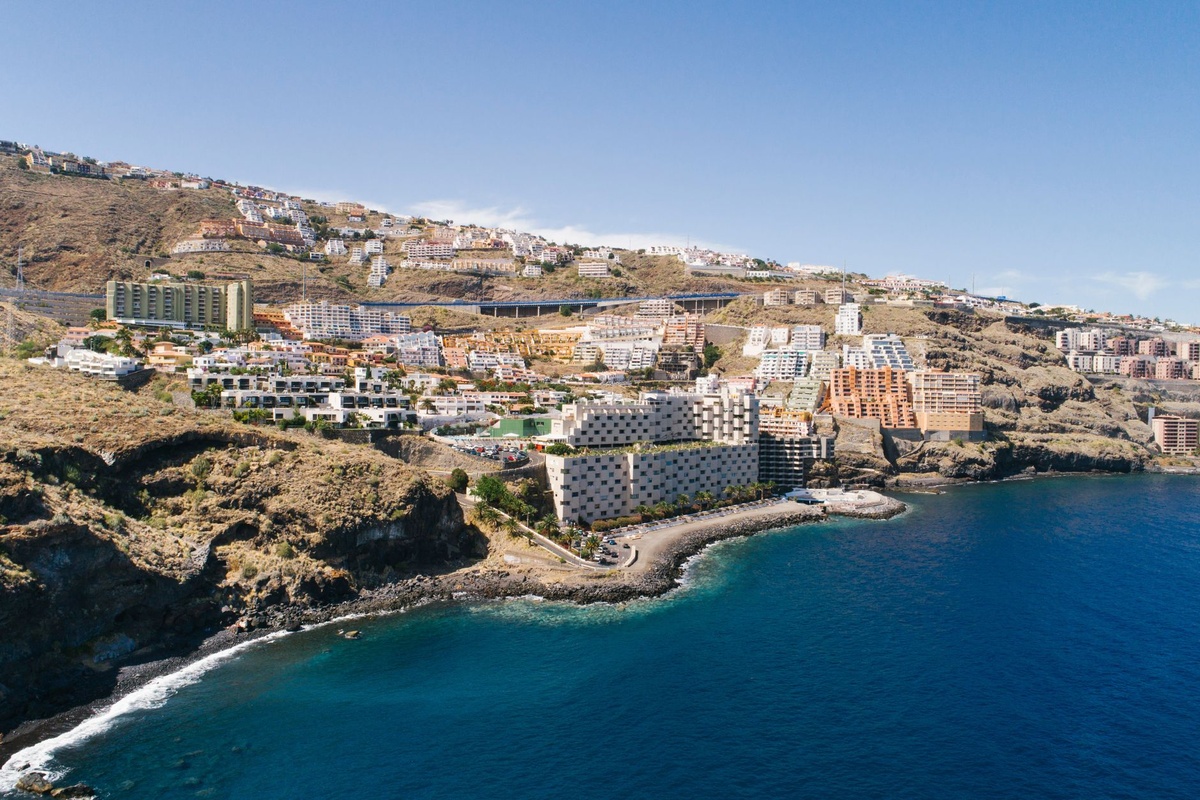
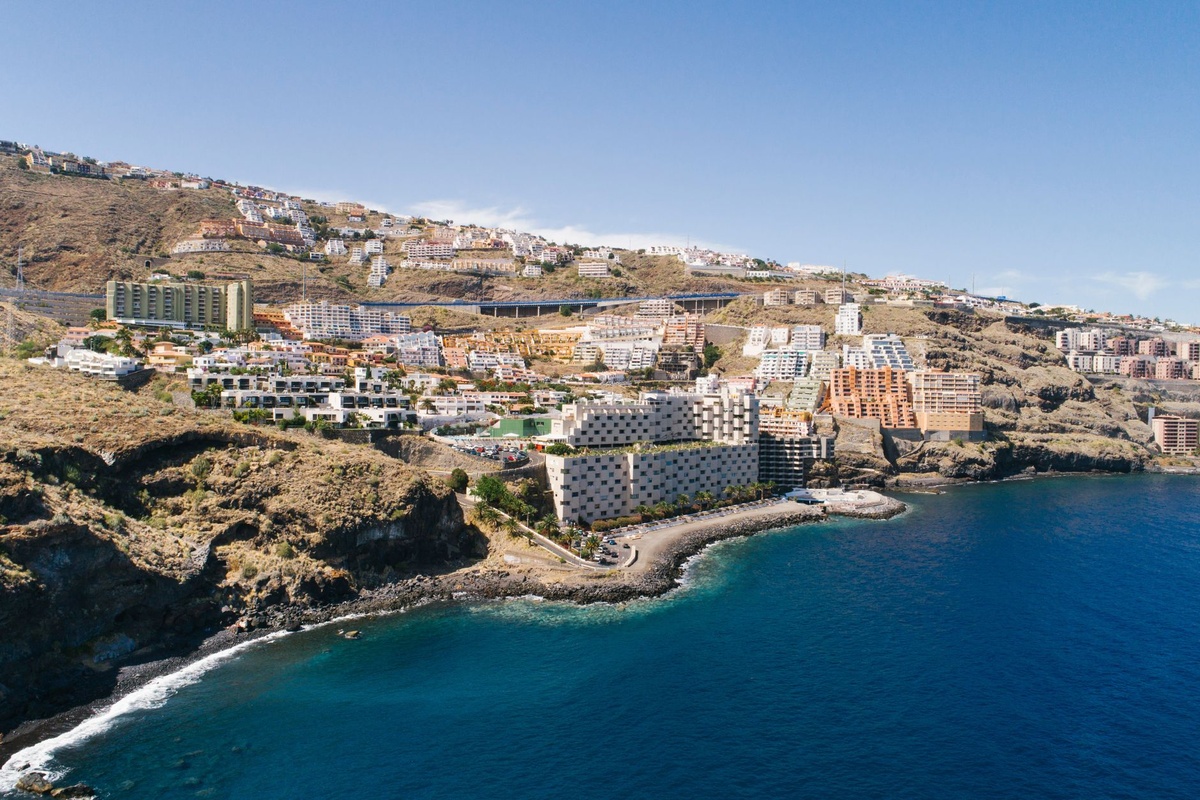
The south of Tenerife sits in the rain shadow of Mount Teide and it shows: around 7 hours of sun a day, 2–3 rain days a month, and a reliable 22°C. It’s the most consistent winter weather in the group and the easiest place to fly into, with 20+ daily low-cost arrivals at Tenerife South (TFS).
The problem is that this consistency is priced in. Playa de las Américas and Costa Adeje are wall-to-wall package resorts, and a one-bed Airbnb in Los Cristianos for February 2027 is listing at €1,400–1,700 for the month. Skip Las Américas entirely. Base in El Médano (25 min from TFS, €1,200–1,500/month), which has the only real town feel in the south, a kitesurf beach and a small nomad crowd, or Los Cristianos if you want walkable ferries and a proper harbour.
Coworking is thinner than you’d expect for the island’s size. Coworking in the Sun in Los Cristianos runs around €150–180 per month for a hot desk, and most El Médano nomads work from cafés or apartments on 300–600 Mbps fibre, standard in anything built after 2010. Ask for a speed-test screenshot before booking.
Transport: TITSA bus 111 from TFS to Los Cristianos costs €2.65 and takes 20 min; a taxi is €25–30. Eat at El Cine in Los Cristianos (grilled fish, €12–15 a plate, no reservations, queue at 1 pm), and ride the cable car up Teide on a cold, clear February morning (€42 return, book at telefericoteide.com days ahead).
Gran Canaria: The Nomad Capital, with Cloud Caveats
Las Palmas de Gran Canaria is the only city in this comparison that feels like a city: 380,000 people, a 3 km urban beach (Las Canteras), a real music scene, and by far the densest coworking and coliving ecosystem in the Atlantic. It has quietly become the Lisbon of winter 2027 for European remote workers.
The weather is the trade-off. Las Palmas sits on the northeast coast, which catches the trade-wind cloud, so January averages 5.7 hours of sun and 5 rain days, roughly an hour less sun per day than Tenerife South. It’s rarely bad weather, just more grey mornings than the south of the island, where Maspalomas enjoys Tenerife-South-level sunshine 50 km and a €7.65 bus ride away (Global line 30, 55 min).
Coworking and coliving options to actually consider:
- Soppa de Azul (Las Canteras end): hot desk from around €130/month, the most social of the lot, strong Thursday meetup culture.
- Restation coliving: private rooms from roughly €900–1,100/month including workspace; book 2–3 months out for February.
- The House Coliving near the Mercado del Puerto: similar pricing, slightly quieter crowd.
Rent is the best value of the three Spanish options. A one-bed near Las Canteras lists at €1,000–1,300 for February 2027 on Airbnb, and €750–950 on Idealista if you can commit to three months and deal with a Spanish-speaking landlord. Global bus 60 from the airport to the centre is €2.95 and takes 30 min; a taxi is €30–35.
Eat at the Mercado del Puerto after 8 pm (tapas €3–5, Tropical beer €2) and skip the tourist paella places on Paseo de las Canteras. The interior is excellent for weekend hikes: Roque Nublo is 1 hr 15 min by car, and the Tejeda villages do a €12 menú del día on Sundays.
Lanzarote: Sunniest and Driest, but Windy and Dusty
On raw sunshine and rain, Lanzarote wins. Arrecife averages 7 hours a day across Jan–Mar and just 10–20 mm of rain a month; it’s the closest thing to a desert climate in Europe. The César Manrique landscape, black lava fields and whitewashed villages are also the most photogenic backdrop of the four by some distance.
The two costs are wind and dust. The northeast trade wind blows hard most afternoons from February onward (20–35 km/h is normal), which drops the felt temperature and makes outdoor laptop sessions impossible. And as the easternmost island it takes the brunt of calima, typically 4–6 episodes a winter. In a bad February you could lose 10–12 days to dusty skies.
The nomad infrastructure is the thinnest here. Arrecife has one or two small coworking spaces and Puerto del Carmen has none worth the name; most people work from apartments. Base in Arrecife (real town, €1,000–1,200/month for a one-bed, 10 min from the airport by taxi for €12–15) or Famara if you surf and can handle 40 km of driving for anything else.
You’ll want a car here more than anywhere else in this comparison: €450–600/month from Cicar or PlusCar in February 2027, booked direct rather than through aggregators. Navigation is simple on an island with four main roads, which is exactly why a paper map does a better job than Google Maps on the unlit LZ-67 through Timanfaya at night. Eat the grilled fish at any of the El Golfo restaurants (€14–18 a plate with a view of the green lagoon) and buy wine direct at Bodega La Geria (€9–14 a bottle).
Funchal: Cheapest, Greenest, Rainiest
Funchal is the outlier. Madeira is a subtropical mountain island, not a desert one, and the price for the banana plantations and 2,000 km of levada trails is rain: 9 days in January, 8 in February, 8 in March, and 65–100 mm a month. Daytime highs sit at 19–20°C, pleasant but a clear step down from the Canaries’ 22–23°C.
In exchange you get the cheapest living, essentially zero calima, excellent fibre (NOS and MEO deliver 500 Mbps for €30/month), and the most organised digital nomad programme in Europe. The Digital Nomads Madeira project runs free coworking at the John dos Passos Cultural Centre in Ponta do Sol (register at digitalnomads.startupmadeira.eu), and Cowork Funchal in the city centre charges around €120–150/month for a desk.
The single most useful tip for Madeira: don’t base in Funchal if sun is your priority. Ponta do Sol and Calheta, 25–35 min west, sit in the island’s driest microclimate and average 1–1.5 more sun hours a day. A one-bed there runs €900–1,200 for February 2027; in Funchal itself expect €1,000–1,300. If you’d rather be in the city, compare hotels in Funchal for the first week while you hunt a monthly place on Idealista.pt or Facebook’s “Madeira Digital Nomads” group.
Airport note: Funchal (FNC) is the trickiest airport in this group. Crosswinds divert flights to Porto Santo or Lisbon a few times a month in winter, so build a buffer day before any critical meeting. The Aerobus to the centre is €5 and takes 35 min; a taxi is €25–30. Skip the overpriced fruit stalls upstairs at Mercado dos Lavradores and eat a €2.50 bolo do caco at the street-level bakeries, then head to O Lagar in Câmara de Lobos for espetada (€16 a skewer) and Taberna da Poncha in Serra de Água for a €3 poncha. Drivers should note that Madeira’s roads are mostly tunnels and GPS drops out constantly, so the “remember the road atlas” advice applies here more than anywhere.
What a Month Actually Costs (February 2027, Solo Nomad)
Prices below are from current listings and operator rate cards for February 2027, assuming a private one-bed apartment booked by mid-December, a coworking hot desk, home cooking plus roughly ten meals out, and no car unless noted. Add €450–600 for a car in Lanzarote.
| Cost item (Feb 2027) | Tenerife South (El Médano) | Gran Canaria (Las Palmas) | Lanzarote (Arrecife) | Funchal / Ponta do Sol |
|---|---|---|---|---|
| 1-bed apartment, 28 nights (Airbnb) | €1,350 | €1,150 | €1,100 | €1,050 |
| Coworking hot desk | €160 | €130 | €120 (limited) | €0–130 |
| Groceries (Mercadona / Pingo Doce) | €280 | €270 | €300 | €260 |
| 10 meals out + coffees | €190 | €170 | €190 | €150 |
| Local transport | €45 | €40 | €35 (+car) | €40 |
| Return low-cost flight from UK/Germany | €120 | €130 | €120 | €180 |
| Mobile data (eSIM, 20 GB) | €25 | €25 | €25 | €25 |
| Monthly total | €2,170 | €1,915 | €1,890 (€2,400 with car) | €1,705–1,835 |
Mobile data: Spain and Portugal are EU, so EU-registered SIMs roam free. UK users on plans that now charge roaming (EE, Vodafone, Three on newer contracts) and anyone from the US or Canada should install an eSIM before landing. An Airalo Europe regional plan runs about €20 for 10 GB or €37 for 20 GB over 30 days; Nomad has a similar Spain-only plan that’s a few euros cheaper if you’re not island-hopping to Madeira.
Decision Framework: Which Base Should You Choose?
- Choose Tenerife South if you want maximum weather certainty, don’t mind resort surroundings, and have the budget for €1,300+ rent. Base in El Médano, not Las Américas.
- Choose Gran Canaria (Las Palmas) if community, coworking and city life matter more than an extra hour of sun. Take a weekend in Maspalomas when you need a sunshine top-up.
- Choose Lanzarote if you’re a surfer or landscape photographer, you’ll rent a car, and you can tolerate wind and 4–6 calima episodes. Avoid February if you have asthma.
- Choose Funchal / Ponta do Sol if cost, hiking and a structured nomad programme outweigh warmth, and 8 rain days a month doesn’t bother you. Base west of Funchal for sun.
- Choose none of these if you need 25°C and a swimmable sea in February; that means Cape Verde (Sal, 24–25°C, sea 22°C) or Oman, both roughly double the flight time and cost.
If you’re torn between a sun base and joining friends on a ski trip first, early December is cheap for both; the budget ski comparison on this site pairs well with a 1 January flight south.
Common Mistakes to Avoid
- Booking Las Américas because it’s “Tenerife South.” It’s the sunniest zone but the least livable. El Médano or Los Cristianos give you the same climate with a town attached.
- Assuming Las Palmas has Maspalomas weather. It doesn’t; the north coast has an hour less sun and nearly double the rain days. Decide which trade-off you want before booking.
- Booking non-flexible Lanzarote flights in February. Calima closures happen; the €10–15 flex upgrade is cheap insurance.
- Basing in central Funchal for sun. Ponta do Sol and Calheta get noticeably more; Funchal gets the rain and the cruise crowds.
- Waiting until January to book accommodation. Jan–Mar is peak season for Northern European retirees in the Canaries; the good monthly Airbnbs are gone by mid-December. Lock in during the Black Friday flight sales this week.
- Skipping the 90-day rule check. Non-EU passport holders get 90 days in the whole Schengen zone across January–March; Madeira and the Canaries count against the same clock. Spain’s digital nomad visa and Portugal’s D8 visa take 2–4 months to process, so apply now if you want to stay beyond March.
- Trusting the “average high” alone. 21°C in the sun at Los Cristianos feels like 25°C; 21°C in a 30 km/h wind at Famara feels like 15°C. Pack a windproof layer for every island.
Sample Plan: A 10-Week Split Winter for Under €5,000
If you have the flexibility, the best answer isn’t one base. Here’s a split that gets the sun when you need it and the community when you want it:
- 5 Jan – 1 Feb, Las Palmas: settle into Soppa de Azul, make friends, take two weekend buses to Maspalomas. ~€1,900.
- 1 Feb – 1 Mar, El Médano: Binter or Canaryfly flight LPA–TFN €35–50 (25 min), bus to the south. Peak-sun month in the driest spot. ~€2,150.
- 1 Mar – 15 Mar, Ponta do Sol: easyJet TFS–FNC via Lisbon or direct seasonal Binter (~€90). Levada hikes, cheap living, no dust. ~€900.
- Total: roughly €4,950 for 10 weeks including inter-island flights, versus €5,400+ staying in Tenerife South throughout.
The order matters: Las Palmas first while the rent is lowest, Tenerife South for the driest month, and Madeira last as the island greens up and March rain eases.
Final Verdict
On weather alone, it’s Lanzarote first, Tenerife South a close second, Gran Canaria third and Funchal a clear fourth. On livability for a remote worker, it’s Las Palmas first by a distance, Funchal/Ponta do Sol second, El Médano third and Lanzarote last. Most people I know who’ve done this winter twice end up in Las Palmas and stop complaining about the clouds, which tells you something.
Decide this week, book the flight in the Black Friday sales, and lock the apartment before 15 December. Then download AEMET, set a Windy dust alert, and spend January watching your home city’s weather from a terrace.
Frequently Asked Questions
Which Canary Island has the best weather in January?
Lanzarote and Tenerife South are the sunniest and driest, with 6.3–6.4 hours of sun a day and only 3–4 rain days in January, against 5.7 hours and 5 rain days in Las Palmas. Daytime highs are 21°C across all three, with the sea at 19–20°C.
Is Madeira warm enough to work remotely in February?
Yes, but expect 19°C highs, around 8 rain days and 85 mm of rain in Funchal. Base in Ponta do Sol or Calheta on the southwest coast for 1–1.5 more sun hours a day and roughly 5–6 rain days instead.
How often does calima happen in the Canaries in winter?
Typically 2–4 episodes between December and March in Tenerife and Gran Canaria, and 4–6 in Lanzarote, each lasting 2–4 days. Madeira is rarely affected. AEMET issues 48-hour warnings via its free app.
How much does a month in Las Palmas cost for a digital nomad?
Around €1,900 in February 2027: €1,150 for a one-bed Airbnb near Las Canteras, €130 for a coworking desk, €270 groceries, €170 eating out and €40 on buses. Three-month leases via Idealista can cut the rent to €750–950.
Can I swim in the sea in the Canaries in March?
The sea is 18–19°C in March, the coolest point of the year. It’s fine for a 15-minute dip but most people swimming daily use a 3/2 mm wetsuit; Madeira is the same temperature.

About the Author: Tomáš Bzirský
Founder and editor of Distratech. Based in the Czech Republic, travelling regularly from Central Europe. Writes practical travel guides and travel-tech comparisons (eSIM, apps, airports) in six languages.