October is the month Namibia runs out of patience with water. Windhoek’s dams typically sit well below half capacity before the first rains arrive in November, the Namib hits 36–38°C by midday, and every lodge pool in the Sossusvlei corridor is topped up from a borehole that was never meant to serve 40 rooms. If you’re bringing two kids into that, the loop you pick matters — not just for your budget, but for how much diesel you burn and how much groundwater you pull out of a desert.
I ran the numbers on the two routes almost every family considers: the classic 2,300 km “big circuit” (Windhoek → Sossusvlei → Swakopmund → Damaraland → Etosha → Windhoek) and the compact 1,150 km “triangle” (Windhoek → Sossusvlei → Swakopmund → Windhoek). The answer isn’t simply “shorter is better.” Where you sleep moves your water footprint by a factor of five; where you drive moves your fuel footprint by a factor of two. Here’s how to make both small.
Key Takeaways
- The compact triangle burns roughly 127 litres of diesel (about €140 at Oct 2026 pump prices) versus 253 litres (about €280) for the full circuit — half the fuel for 60% of the highlights.
- Camping at NWR sites uses an estimated 60–80 litres of water per person per day, versus 300–500 litres at a luxury desert lodge with a pool — accommodation choice matters far more than route length.
- October is Etosha’s peak: animals cluster at waterholes, so a family can log 2–3 lion or elephant sightings in a 40 km morning loop instead of a 150 km hunt.
- A 14-day camping version of the full circuit costs about €4,500 for a family of four excluding flights; the 8-day triangle costs about €2,430.
- Book NWR campsites at Sesriem and Okaukuejo 6–9 months ahead at nwr.com.na — October 2026 weekends were already thin by spring.
Key Numbers at a Glance
All prices are what we calculated for October 2026 using a pump price of N$21.50 per litre of diesel (≈€1.10) and a Toyota Hilux 2.4 double cab with two rooftop tents averaging 11 L/100 km on loaded gravel. Water figures are estimates built from NWR campsite metering, lodge sustainability reports and our own jerry-can tallies.
| Metric | Full circuit (13 nights) | Compact triangle (7 nights) |
|---|---|---|
| Total driving distance | ~2,300 km | ~1,150 km |
| Gravel share | ~68% | ~45% |
| Diesel burned | ~253 L | ~127 L |
| Fuel cost (Oct 2026) | ~€280 | ~€140 |
| Tailpipe CO₂ (2.68 kg/L) | ~678 kg | ~340 kg |
| Driving days vs activity days | 6 vs 7 | 3 vs 4 |
| Water footprint, camping-based | ~3,900 L (≈75 L/pp/day) | ~2,100 L (≈75 L/pp/day) |
| Water footprint, lodge-based | ~16,000 L (≈300 L/pp/day) | ~8,400 L (≈300 L/pp/day) |
| Total cost excl. flights, camping | ~€4,500 | ~€2,430 |
| Cost per activity day | ~€640 | ~€610 |
Read that last row twice. Per day of actually doing something, the two loops cost almost the same. The circuit’s extra fuel is real, but it buys you Etosha in its best month, which is the one thing the triangle cannot replace.
Why October Changes the Maths
Namibia’s rains fall December to March. By October the country has gone seven months without meaningful rainfall, and the consequences land directly on your trip.
In Etosha, every animal within 30 km is drinking at one of a dozen reliable waterholes. That’s why October game drives are short: at Okaukuejo you can park at the floodlit waterhole after dinner, drive zero kilometres, and watch black rhino, elephant and giraffe arrive in rotation. In March, the same sightings might cost you 200 km of fruitless driving on wet tracks.
In the Namib, it means heat. Sossusvlei is 36–38°C by 11:00, so the dune climb has to happen between gate opening (around 06:15 in October) and 09:30. A family of four will realistically drink 14–16 litres a day here — budget for it.
In Windhoek, it means restrictions. The city has relied on direct potable reuse from the Goreangab plant since the 1960s and typically sits at a Category C or D water-saving level by October. Swakopmund, by contrast, draws most of its supply from the Erongo desalination plant at Wlotzkasbaken, so a shower there has a fundamentally different footprint than a shower in Sesriem.
Route A: The Full Circuit, Leg by Leg
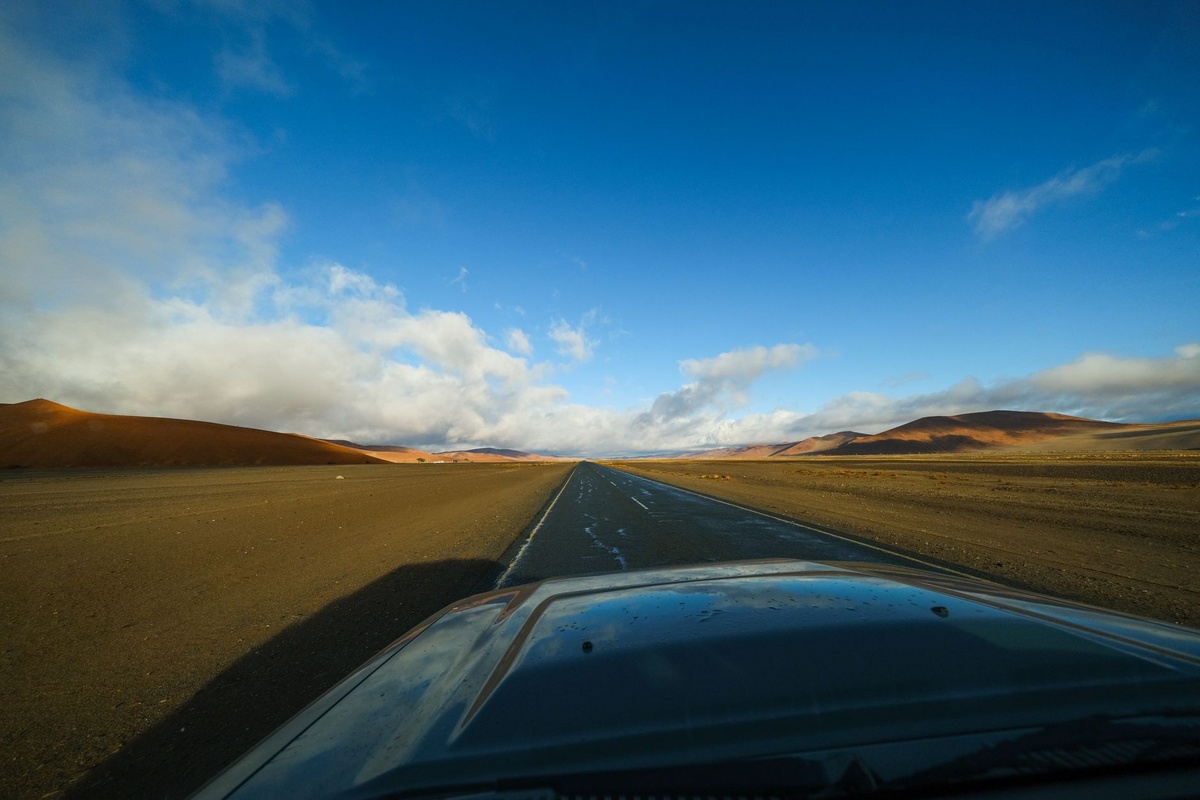
Windhoek → Sesriem (320 km, 5 hours, 90% gravel)
Leave Windhoek by 08:00 via the C26 over the Spreetshoogte or Gamsberg Pass, not the tar-and-boring B1 south. Fill up at Rehoboth or before you leave Windhoek — the Solitaire station has fuel but has run dry on October weekends more than once. Fuel used: ~37 L.
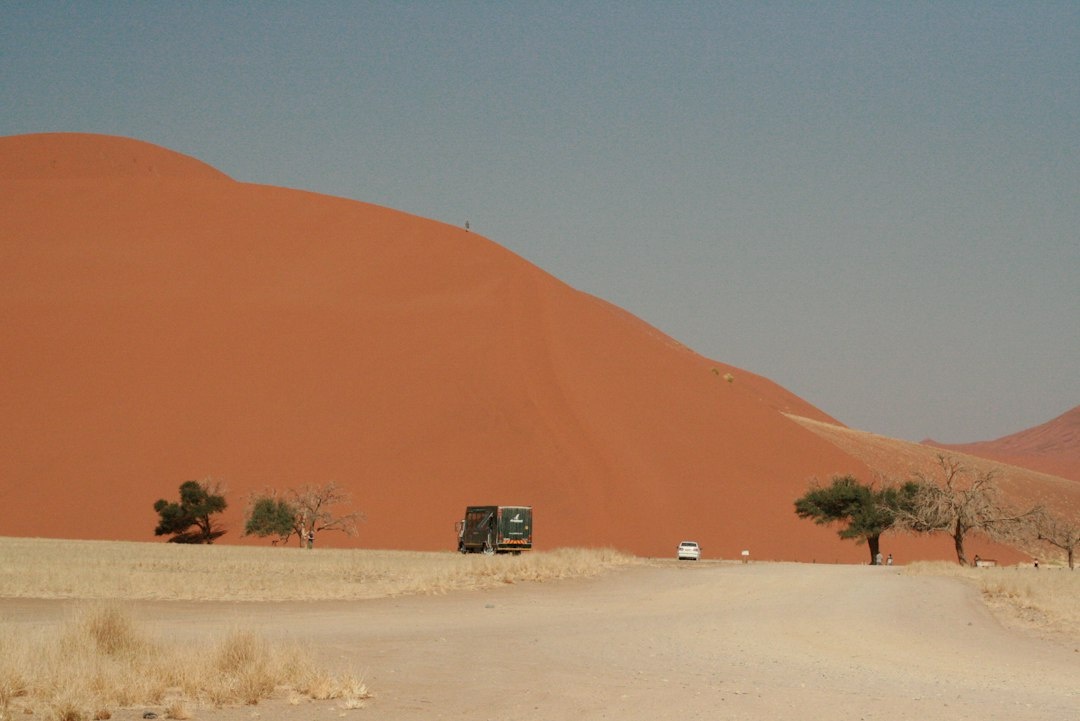
Stay inside the park gate at the NWR Sesriem Campsite (N$600 per adult, children 6–16 half price, ~€75 per night for the family). Camping inside the gate lets you enter the dune road an hour before outside guests, which in October is the difference between climbing Dune 45 in the cool and climbing it in a hairdryer.
Sesriem → Sossusvlei and back (130 km round trip, 2 hours driving)
With your own 4×4 you drive the final 5 km of deep sand yourself and skip the N$200 pp shuttle. Deflate to 1.2 bar, stay in second gear low range, and you’ll be fine. Day permit: N$150 per adult plus N$50 per vehicle (children under 16 free), about €20 total.
Sesriem → Swakopmund (350 km, 5–6 hours, 85% gravel)
Through Solitaire (stop for apple pie at McGregor’s Bakery, N$45 a slice), the Kuiseb Canyon and the Tropic of Capricorn sign. The last 40 km into Walvis Bay is tar. Fuel: ~40 L. Temperature drops 15 degrees in the final hour as you hit the coastal fog belt — kids who were melting at breakfast will want fleeces by dinner.
Two nights at Cornerstone Guesthouse (family room ~€120/night, Oct 2026) or Desert Breeze Lodge (~€190). Eat at Jetty 1905 for oysters and the sunset, and Village Café for breakfast. Skip the Tug — good view, tired food, tourist pricing.
Swakopmund → Twyfelfontein (390 km, 6 hours, 75% gravel)
North on the salt road to Henties Bay, then inland via Uis (fuel here, no exceptions — it’s the last reliable pump before Khorixas). Fuel: ~45 L. The Brandberg massif rises on your left for an hour.
Madisa Camp (N$350 pp, ~€55 family) has its own waterhole where desert elephants visit in the dry months — October is the best odds of the year. The campsites have open-air showers fed by a solar pump, which keeps consumption honest. Twyfelfontein Country Lodge (~€260 family) is the comfortable alternative, but its lawns and pool are exactly the water story you’re trying to avoid.
Twyfelfontein → Etosha, Okaukuejo (350 km, 5 hours, 50% gravel)
Via Khorixas and Outjo, then the C38 to Anderson Gate. Tar from Outjo onward. Fuel: ~38 L. Arrive by 15:00 so you catch the 16:00–18:00 waterhole rush on day one.
Three nights at NWR Okaukuejo campsite (N$500 pp, ~€65 family per night). Park fees N$150 per adult per day plus N$50 vehicle, children free — about €19 a day. The floodlit waterhole is 100 metres from the tents.
Etosha → Windhoek (430 km, 5 hours, 100% tar)
Via Outjo, Otjiwarongo and Okahandja on the B1. Fuel: ~40 L. Stop at Okahandja woodcarvers market if the kids need to spend their last Namibian dollars. Return the car with a full tank at Hosea Kutako airport — most rental firms charge N$35/L to refill it themselves.
Route B: The Compact Triangle
The triangle uses the first two legs above exactly as written, then closes the loop on the B2 from Swakopmund to Windhoek: 360 km, 4 hours, entirely tar through Usakos and Karibib. Fuel: ~32 L at the better tar-road consumption of 9 L/100 km.
What you gain: two fewer 6-hour gravel days, which with a six-year-old is not a small thing. You also gain time — spend the saved days doing the Living Desert Tour in Swakopmund (N$1,200 pp, kids N$700, about €150 for the family, via livingdeserttours.com.na), which is the best child-friendly nature activity in the country.
What you lose: Etosha. In October, that’s a heavy loss. There is no waterhole in the triangle that puts a rhino 30 metres from your campsite.
Head-to-Head Comparison Table
| Leg | Distance | Surface | Drive time | Diesel (L) | Fuel cost Oct 2026 | Full circuit | Triangle |
|---|---|---|---|---|---|---|---|
| Windhoek → Sesriem | 320 km | Gravel | 5 h | 37 | €41 | ✔ | ✔ |
| Sossusvlei dune road (return) | 130 km | Tar + sand | 2 h | 15 | €17 | ✔ | ✔ |
| Sesriem → Swakopmund | 350 km | Gravel | 5.5 h | 40 | €44 | ✔ | ✔ |
| Swakopmund → Twyfelfontein | 390 km | Gravel/salt | 6 h | 45 | €50 | ✔ | — |
| Twyfelfontein → Okaukuejo | 350 km | Mixed | 5 h | 38 | €42 | ✔ | — |
| Etosha game drives (3 days) | ~300 km | Gravel | ~9 h | 38 | €42 | ✔ | — |
| Okaukuejo → Windhoek | 430 km | Tar | 5 h | 40 | €44 | ✔ | — |
| Swakopmund → Windhoek | 360 km | Tar | 4 h | 32 | €35 | — | ✔ |
| Total | 2,270 / 1,160 km | 37.5 / 16.5 h | 253 / 124 | €280 / €137 |
The fuel gap is real but smaller than the headline suggests once you price it: €143 of diesel over a two-week family holiday. The water gap is where the decision actually lives.
The Water Footprint Table Nobody Publishes
Lodges in Namibia rarely publish per-guest water figures, so these are estimates built from NWR campsite metering data, published sustainability audits from Wilderness and Gondwana properties, and our own measurements with a 20-litre jerry can. Treat them as order-of-magnitude, not audit-grade.
| Accommodation type (Oct 2026) | Est. water per person per day | Family of four, per night | Example | Price (family, Oct 2026) |
|---|---|---|---|---|
| Self-catered camping, bucket shower | 40–50 L | ~180 L | Madisa Camp | ~€55 |
| NWR campsite, shared ablutions | 60–80 L | ~280 L | Sesriem, Okaukuejo | ~€65–75 |
| Guesthouse in Swakopmund (desalinated supply) | 120–150 L | ~540 L | Cornerstone | ~€120 |
| Mid-range lodge with pool, Damaraland | 250–350 L | ~1,200 L | Twyfelfontein Country Lodge | ~€260 |
| Luxury desert lodge, private plunge pools | 400–600 L | ~2,000 L | Sossusvlei corridor high-end | €900–1,800 |
Now apply that to the loops. A family doing the full circuit entirely in mid-range lodges uses roughly 16,000 litres over 13 nights. The same family camping uses under 4,000. The compact triangle in lodges uses around 8,400 — still more than double the full circuit camped.
That’s the headline: a family that camps the full circuit has a smaller water footprint than a family that lodges the short one. Route length is the secondary variable.
Decision Framework: Which Loop Should You Choose?
- Choose the full circuit if your youngest is 7 or older, you have 13+ nights on the ground, and you’re willing to camp at least 9 of them. Etosha in October is a once-in-a-childhood wildlife experience and the camping offsets the extra 130 litres of diesel many times over on water.
- Choose the compact triangle if you have under 10 nights, a child under 6 who won’t tolerate 6-hour gravel days, or you’re committed to lodges for sleep reasons. You’ll burn half the fuel and the Living Desert Tour plus Sossusvlei gives the kids a strong nature narrative.
- Choose a third option — the “Etosha north loop” (Windhoek → Etosha → Waterberg → Windhoek, ~950 km, all tar) — if wildlife is the priority and you only have a week. It’s the lowest fuel option per sighting in October, with a footprint close to the triangle’s and no gravel at all.
- Don’t choose the full circuit crammed into 9 nights. You’ll drive 2,300 km with two activity-free days, and the per-day fuel burn goes up while enjoyment goes down.
Costed Sample Plan: 14-Day Full Circuit, Camping-First
This is the plan we’d actually book for two adults and kids aged 8 and 11, prices in EUR as quoted for October 2026.
| Item | Detail | Cost (EUR, Oct 2026) |
|---|---|---|
| 4×4 rental, 14 days | Toyota Hilux 2.4 DC, 2 rooftop tents, fridge, full camping kit, from Asco Car Hire or Namibia2Go; ~€135/day incl. zero-excess cover | €1,890 |
| Diesel | ~253 L at ~€1.10/L | €280 |
| Camping, 10 nights | Sesriem ×2, Madisa ×2, Okaukuejo ×3, Halali ×1, Windhoek Urban Camp ×2 | €680 |
| Guesthouse, 3 nights | Cornerstone Swakopmund ×2, Windhoek first night | €360 |
| Park fees | Namib-Naukluft 2 days, Etosha 4 days, Twyfelfontein site | €135 |
| Activities | Living Desert Tour, Twyfelfontein guide, Sesriem Canyon walk | €200 |
| Groceries and self-catering | Checkers/Spar Windhoek, Woermann Brock Swakop; ~€45/day | €630 |
| Restaurant meals | Joe’s Beerhouse, Jetty 1905, Okaukuejo buffet ×1 | €220 |
| Water, ice, firewood | 5 L bottles at ~€1.50, ice at ~€1 per 2 kg bag | €65 |
| Connectivity | Two eSIMs plus one MTC local SIM | €40 |
| Total on the ground | ~€4,500 | |
| Flights (not included) | Eurowings Discover FRA–WDH return, Oct 2026 fares seen at ~€950–1,150 pp | ~€4,200 |
Swap the 10 camping nights for mid-range lodges and the on-the-ground total climbs to roughly €7,800 — and your water footprint quadruples. That’s the whole argument for the rooftop tent.
If you’ve never done a multi-day vehicle-based trip with children, our breakdown of what actually matters on a first family road trip with kids on board covers the seat-anchor and routine questions that apply just as much to a Hilux in the Namib as a camper van in Vermont.
Cutting Fuel and Water Further: What Actually Works
- Drop tyre pressure to 1.6 bar on gravel and keep to 80 km/h. You’ll cut punctures, and the smoother ride reduces the constant braking-and-accelerating that pushes consumption toward 13 L/100 km.
- Carry two 20 L water jerry cans and refill at every campsite tap. Namibian tap water is potable almost everywhere outside the far north. You’ll avoid roughly 60 single-use 5 L bottles over two weeks.
- Shower in Swakopmund, not Sesriem. Desalinated coastal water versus desert borehole water — same shower, very different footprint. Kids’ hair-washing days belong on the coast.
- In Etosha, sit rather than drive. October is the one month where a 40 km Okaukuejo–Nebrownii–Okondeka loop plus the camp waterhole outperforms a 150 km all-day traverse. We saw 11 species before 09:00 without passing Gemsbokvlakte.
- Use the fridge, not a cooler box. A 12 V Engel or National Luna is standard on rental 4x4s. Running it is cheaper than buying ice daily and stops you driving into town for supplies.
- Buy groceries once in Windhoek, top up once in Swakopmund. Supermarket detours in Namibia cost 50–100 km each.
- Load Tracks4Africa (about €30 for the Africa map) and keep Maps.me offline. Google Maps will route you onto a D-road that adds 90 minutes and 15 litres. Tracks4Africa knows which fuel stations are real.
Common Mistakes Families Make on Both Loops
- Booking Sossusvlei lodges outside the gate to save money. You’ll enter at sunrise instead of an hour before, and in October that puts you on Dune 45 at 08:30 in 32°C heat with grumpy children.
- Assuming fuel at Sesriem or Solitaire. Both have run dry on October weekends. Fill in Windhoek, fill in Swakopmund, fill in Uis, fill in Outjo. Treat every pump as the last one.
- Driving after 17:30. Kudu and warthog cross the C-roads at dusk, and a rental Hilux with a bullbar still comes off worse. Etosha gates also close at sunset (about 19:00 in October) with real fines.
- Skipping the second night in Damaraland. One night means you arrive at 16:00 and leave at 08:00 — no time for the Twyfelfontein engravings (N$150 pp, guide included, open 08:00–17:00) or the elephant wait.
- Relying on mobile data. MTC coverage disappears 30 km outside every town. Download everything in Windhoek. For the stretches with signal, an Airalo Namibia eSIM (about €12 for 3 GB) saves the airport SIM queue, and a Garmin inReach Mini is the right call for the Damaraland leg where nothing else works.
- Treating October like winter. Namibia’s June–August brochure photos lie about October. It’s 36°C at Sossusvlei and 35°C at Etosha. Sun hats, 3 L of water per person before noon, and a strict 11:00–15:00 rest rule.
Where to Base Yourself in Windhoek on Arrival and Departure
Almost everyone sleeps one night in the capital before collecting the 4×4. Urban Camp (N$280 pp camping, or safari tents from ~€75 for a family) lets you test the rooftop tents in a safe lot before the real gravel. Olive Grove Guesthouse (~€140 family room) is the comfortable alternative if you’ve landed off a 10-hour overnight flight.
Dinner on night one is Joe’s Beerhouse (Nelson Mandela Avenue, open 17:00–23:00, mains N$180–320). It’s touristy and it’s still correct — the kids will eat zebra steak and talk about it for a year. Compare hotels in Windhoek early; October is high season and family rooms under €150 go first.
The Verdict
On raw fuel, the compact triangle wins by 130 litres and about €143. On raw water, the loop is nearly irrelevant — camping versus lodging is a 4–5x swing while route length is a 2x swing at most.
So the lowest-footprint Namibia trip for a family of four in October is the full circuit, camped at NWR and community sites, with lodge nights only in Swakopmund where the water is desalinated. It costs about €4,500 on the ground, burns 253 litres of diesel, uses under 4,000 litres of water across 13 nights, and puts your kids 30 metres from a black rhino at a floodlit waterhole in the one month that almost guarantees it.
If you only have a week, do the triangle, camp it, and put the fuel savings into the Living Desert Tour. Either way, book Sesriem and Okaukuejo on nwr.com.na this week — October 2027 campsites open for booking a year out and the gate-side pitches disappear by Christmas.
Frequently Asked Questions
How much does a 4×4 with rooftop tents cost to rent in Namibia in October?
Expect €120–160 per day in October 2026 for a Toyota Hilux double cab with two rooftop tents, fridge and full camping kit from established firms like Asco Car Hire or Namibia2Go. Zero-excess insurance adds about €20–25 per day and is worth it — a single gravel-road windscreen replacement costs around €350.
How much fuel does the Windhoek–Sossusvlei–Swakopmund–Damaraland–Etosha loop use?
Roughly 250 litres of diesel over 2,300 km at a realistic 11 L/100 km on loaded gravel, which at the October 2026 pump price of about N$21.50 (€1.10) per litre comes to around €280. The compact Sossusvlei–Swakopmund triangle uses about half that: 125 litres and €140.
Is October a good month for a Namibia self-drive with kids?
It’s the best month for Etosha wildlife because animals concentrate at waterholes before the November rains, but it’s also one of the hottest, with 36–38°C at Sossusvlei. Plan dune climbs before 09:00, rest between 11:00 and 15:00, and budget 3–4 litres of drinking water per person per day.
Is camping or staying in lodges better for the environment in Namibia?
Camping uses an estimated 60–80 litres of water per person per day at NWR sites versus 250–500 litres at lodges with pools and lawns, so a family camping for 13 nights uses roughly a quarter of the water a lodge-based family does. In a drought-prone October, accommodation choice has a bigger footprint impact than which loop you drive.
How far ahead do I need to book Sesriem and Okaukuejo campsites?
Book 6–9 months ahead at nwr.com.na for October dates; gate-side pitches at Sesriem and the waterhole-adjacent sites at Okaukuejo typically sell out first. If NWR is full, Sossus Oasis and Desert Camp (just outside the Sesriem gate) and Etosha Trading Post (outside Anderson Gate) are the reliable fallbacks.

About the Author: Tomáš Bzirský
Founder and editor of Distratech. Based in the Czech Republic, travelling regularly from Central Europe. Writes practical travel guides and travel-tech comparisons (eSIM, apps, airports) in six languages.