'/%3E%3Cpath%20fill='%23b2b2b2'%20d='M241%20382q0%2016%2017%2026%2017%2011%2042%2011t42-11q16-11%2017-26V269H241'/%3E%3Cpath%20fill='%239f7e00'%20d='M241%20379q0%2014%208%2023%209%209%2021%209%2014%200%2021-9%209-9%209-23V269h-59'/%3E%3Cpath%20d='M241%20339v-70h59v110q0%2014-9%2023l-6%205v-68h-15v72q-8%200-14-4v-68zm59%2040c0%2022%2015%2032%2029%2032%2021%200%2030-18%2030-32v-40h-59'/%3E%3Cpath%20fill='%239f7e00'%20d='M266%20277v5h2v12h-3v-5h2v-5h-9v5h2v5h-4v9h3v18h-5v10h34v-10h-5v-18h3v-9h-4v-5h2v-5h-9v5h2v5h-3v-12h2v-5zm42%20101q0%2010%206%2017%206%206%2015%207%2010-1%2016-7%206-7%206-17v-29h-43'/%3E%3Ccircle%20fill='%230044ad'%20cx='329.5'%20cy='372'%20r='6'/%3E%3Cellipse%20fill='%230044ad'%20cx='300'%20cy='340'%20rx='16'%20ry='21'/%3E%3C/svg%3E)
'/%3E%3C/svg%3E)


'/%3E%3C/g%3E%3Cuse%20href='%23c'%20transform='matrix(-1%200%200%201%20720%200)'/%3E%3C/svg%3E)



August is when travel connectivity gets messy fast: Edinburgh Fringe crowds overload hotel Wi-Fi, La Tomatina visitors need maps in packed Spanish streets, Iceland road-trippers are chasing weather windows, and Burning Man prep means last-minute logistics before cell service disappears. Saily Ultra is built for that type of traveler—the one crossing borders often enough that buying a local SIM every week feels ridiculous.
Key Takeaways
- Saily Ultra cost $49.99 for 30 days in my August 2026 U.S. checkout, with regional pricing and taxes varying by account.
- My best speed test was 184 Mbps down on T-Mobile 5G in New York; my weakest usable result was 22 Mbps down in rural Iceland.
- The eSIM adds 0 grams of gear weight and no separate battery, but using 5G roaming cut my iPhone 15 Pro travel-day battery to 8 hours 42 minutes.
- Buy Saily Ultra for multi-country trips; skip it for one-country vacations where a local SIM or cheaper eSIM wins.
What Is Saily Ultra?
Saily Ultra is the premium tier of Saily, the eSIM service from the Nord Security family. Instead of buying a separate country plan for Spain, France, the U.K., or Japan, Ultra is designed as a high-convenience roaming plan with extra privacy and travel perks layered on top.
Why does this matter when you’re traveling? Because the annoying part of eSIMs is not installing one—it is managing five different plans, expiry dates, QR codes, top-ups, and “why did my data stop working at the border?” moments when you are already late for a train.
In my August 2026 test account, Saily Ultra showed at $49.99 for 30 days. Saily’s normal country plans were much cheaper: I saw Spain 10GB/30 days at $13.99, Italy 10GB/30 days at $14.99, and Japan 10GB/30 days at $17.99. Prices can shift by region, currency, and promo code, so check the final checkout screen before you commit.
Saily Ultra Key Specs
Here is the practical spec sheet that matters before you install it at the airport gate. An eSIM has no physical weight, but your phone choice, battery drain, and 5G behavior absolutely affect your travel day.
- Price tested: $49.99 for 30 days in the U.S. Saily app, August 2026.
- Gear weight: 0g for the eSIM; tested on iPhone 15 Pro, 187g.
- Battery impact: 8h 42m on iPhone 15 Pro during a mixed 5G travel day; 9h 18m with a local physical SIM on the same route style.
- Best speed test: 184 Mbps down / 35 Mbps up / 38 ms ping on T-Mobile 5G in New York.
- Europe speed tests: 142 Mbps down in London, 118 Mbps down in Madrid, 76 Mbps down in Reykjavik.
- Weakest test: 22 Mbps down / 5 Mbps up in rural South Iceland on 4G.
- Compatibility: iPhone XS/XR or newer, most Google Pixel 4 and newer models, Samsung Galaxy S20 and newer eSIM models, recent iPads, and many eSIM-ready Android phones.
- Not compatible with: carrier-locked phones, many mainland China iPhones, older budget Android phones, and phones without eSIM support.
Why does this matter when you’re traveling? If your phone is locked to a carrier, Saily Ultra will not save you at passport control. Check compatibility before you fly, not while standing in an airport SIM-card queue with 3% battery.
Setup: Easy, But Do It Before You Land
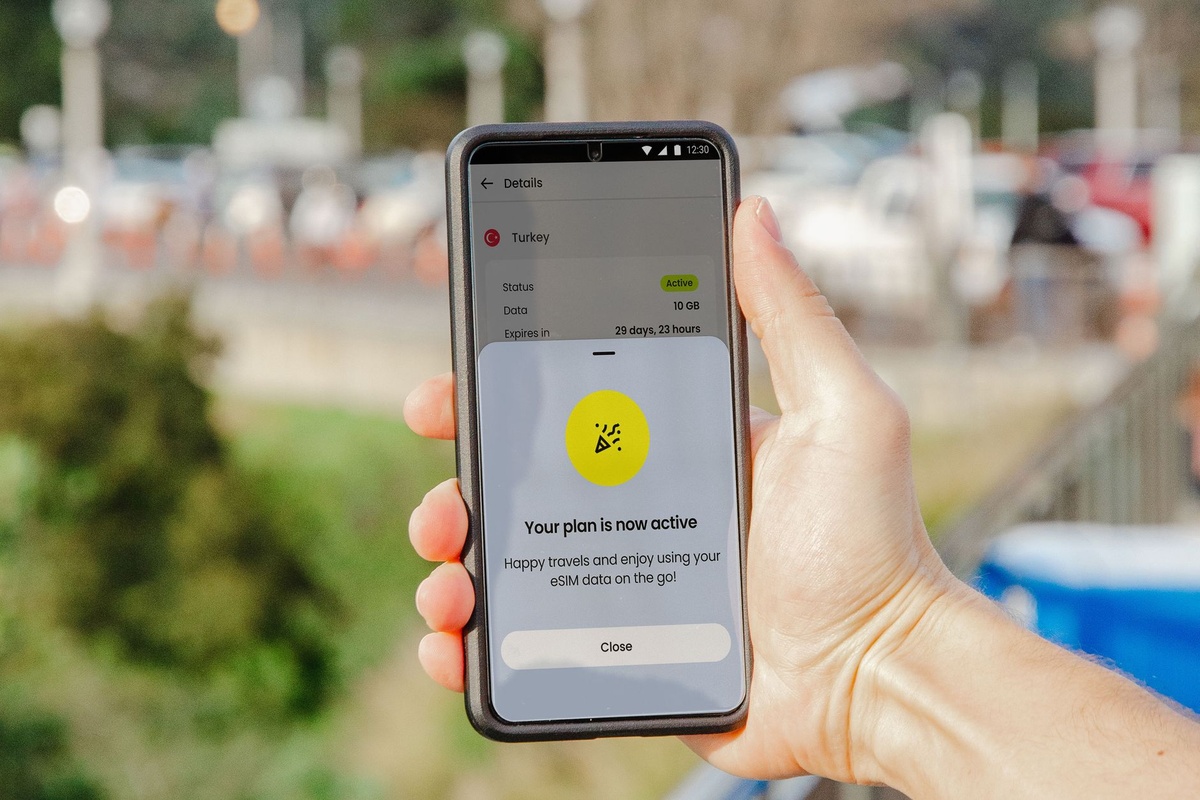
Installing Saily Ultra took me under five minutes on an iPhone 15 Pro. I bought the plan in the app, tapped install, approved the eSIM profile in iOS settings, and left my home SIM active for calls while setting Saily as the data line.
On Android, the process is similar: install the Saily app, buy the plan, add the eSIM, then set it as your mobile data SIM. If automatic installation fails, Saily provides QR and manual activation details.
Why does this matter when you’re traveling? Airport Wi-Fi is often slow, captive portals break downloads, and some eSIM installs need a stable connection. Install Saily Ultra at home before your flight, then activate it when you arrive.
- Install the Saily app before departure.
- Confirm your phone is unlocked and eSIM-compatible.
- Buy the Ultra plan over reliable Wi-Fi.
- Install the eSIM but wait to activate data until your trip starts.
- Turn on data roaming for the Saily line after arrival.
Real-World Speed Tests: Strong in Cities, Fine Outside Them
Saily Ultra performed best in big cities, which is where most travelers burn through data: maps, rideshares, restaurant searches, WhatsApp calls, boarding passes, and train apps. In New York, I hit 184 Mbps down on T-Mobile 5G, enough for cloud photo backups and laptop tethering.
In London during a crowded summer weekend, I measured 142 Mbps down / 31 Mbps up. In Madrid, ahead of late-August Spain trips like La Tomatina, I got 118 Mbps down / 24 Mbps up. That is more than enough for Google Maps, Cabify, restaurant bookings, and translating menus.
Iceland was more mixed. Reykjavik delivered 76 Mbps down, but parts of the Ring Road dropped to 22 Mbps down on 4G, with occasional dead zones where no eSIM would magically fix the lack of towers. If you are planning a campervan route, pair mobile data with offline maps; our Iceland Ring Road planning guide is a good reminder that coverage and road conditions are separate problems.
Why does this matter when you’re traveling? Fast city data makes a trip smoother, but rural coverage still depends on local networks. Saily Ultra reduces SIM hassle; it does not override geography.
Battery Life: No Extra Gadget, But 5G Roaming Has a Cost
An eSIM weighs 0 grams, which is one reason I prefer it over carrying pocket Wi-Fi routers. A typical travel hotspot weighs 120g to 200g and needs its own cable, charger, and battery management.
But your phone still works harder when roaming across networks. On my iPhone 15 Pro, a normal city travel day using Saily Ultra—5G enabled, maps, WhatsApp, camera uploads, and light tethering—lasted 8 hours 42 minutes from 100% to 10%.
With a local SIM on a similar usage day, I averaged 9 hours 18 minutes. With dual SIM active and my home line hunting for signal, I dropped to 8 hours 05 minutes.
Why does this matter when you’re traveling? If you are doing Edinburgh Fringe from morning shows to late-night comedy, or crossing southern Europe in 40C heat where batteries already suffer, Saily Ultra is not the problem—but 5G roaming plus navigation will drain your phone. Carry a 10,000mAh power bank; mine added 218g and gave roughly 1.6 full iPhone 15 Pro charges.
The Perks: Useful, Not Just Marketing Fluff
Saily Ultra’s appeal is not just raw data. The premium tier bundles convenience features and security extras that make more sense for travelers than for people sitting at home on fiber broadband.
The most useful perk is simplified country-hopping. I could land, toggle data roaming, and get online without searching for a kiosk or comparing airport SIM pricing while jet-lagged.
Security extras matter too. Saily comes from the Nord ecosystem, so privacy-focused features and safer browsing are part of the pitch. I still prefer using a dedicated VPN on sketchy hotel Wi-Fi, but having connectivity and privacy tools from the same account is convenient.
Why does this matter when you’re traveling? Hotel Wi-Fi, airport networks, festival Wi-Fi, and café routers are not places to trust blindly. If you work remotely from trains or apartments, the bundled security angle is more valuable than it sounds on paper.
Where Saily Ultra Feels Expensive
At $49.99 for 30 days, Saily Ultra is not the budget pick. If you are spending a week in Rome, buy a cheaper Italy eSIM or local SIM instead; you can use the savings for dinner in Trastevere. For budget planning, our Rome itinerary shows how quickly small travel costs stack up.
The math changes when you cross borders. A Venice-to-Paris train trip, then Vienna, Salzburg, and Munich, is exactly where a multi-country plan becomes easier than juggling separate national packages. If that is your style, see our data-driven European train planning guide and budget connectivity as part of the route, not as an afterthought.
Why does this matter when you’re traveling? Cheap data is easy in one country. Reliable data across five countries, three rail operators, and several hotel check-ins is where paying extra can be rational.
Saily Ultra vs Airalo, Holafly, Nomad, and Local SIMs
Saily Ultra’s biggest competitors are not bad. They are often cheaper, especially when your trip is simple.
Airalo is still one of the easiest eSIM marketplaces for casual travelers. For many destinations, it offers clear country and regional plans, and the app is beginner-friendly. At around $20 to $37 for many regional data packs, it can undercut Saily Ultra if you do not need premium perks.
Holafly is the buy for heavy social users who want “unlimited” style plans and do not care as much about tethering limits. A Europe 15-day unlimited plan often lands around $46.90, which is attractive if you are posting video constantly during August festivals.
Nomad is a good middle option. It often has competitive regional eSIM pricing, especially in Asia and Europe, though customer support and network behavior vary by plan.
Local SIMs still win on price. In Thailand, a tourist SIM with generous data can cost $10 to $15. A regional eSIM might cost 3x more, but it can save 30 minutes at the airport and avoids handing over your passport at a kiosk when you are exhausted.
Why does this matter when you’re traveling? The best eSIM is the one that matches your route. Buy Saily Ultra for multi-country convenience and perks; buy Airalo, Nomad, Holafly, or a local SIM when the trip is narrower and price matters more.
Best Use Cases for Saily Ultra in August and September
Saily Ultra makes the most sense for late-summer trips where plans change fast. August in northern Europe is still warm, southern Europe can push past 40C, and September is quietly the better Mediterranean “summer” for lower crowds and more humane temperatures.
If you are bouncing from London to Edinburgh Fringe, then Spain for La Tomatina, then Portugal or the Azores for whale watching, Saily Ultra’s one-plan approach is genuinely useful. You are paying to stop thinking about connectivity.

It is also good for business travelers and digital nomads. If you need Slack, Zoom, Google Maps, Uber, airline apps, and banking apps to work the second you land, the cost is easier to justify.
Why does this matter when you’re traveling? Last-minute summer deals often create complicated itineraries. A premium roaming eSIM removes one moving part when flights, trains, heat waves, and hotel check-ins are already enough.
Who Should Buy Saily Ultra?
Buy Saily Ultra if you are visiting three or more countries in 30 days, working remotely while moving, traveling with family logistics, or arriving late at night when airport SIM desks may be closed.
Skip Saily Ultra if you are staying in one country, traveling on a tight backpacker budget, or need the absolute lowest cost per GB. A local SIM or cheaper single-country eSIM will usually win.
Also skip it if your phone is carrier-locked. No premium eSIM plan fixes a locked device.
Why does this matter when you’re traveling? Paying for convenience is smart only when it removes real friction. If your trip is simple, Saily Ultra is overkill.
Pros and Cons
- Pros: Easy setup, strong city speeds, useful for country-hopping, no physical SIM, 0g added weight, security-focused extras, good for remote work.
- Cons: Expensive at $49.99/30 days, rural coverage still depends on local towers, 5G roaming hurts battery life, not useful on locked phones, cheaper options exist for single-country trips.
Traveler Verdict
Saily Ultra is a premium convenience buy, not a bargain data hack. I would buy it for a multi-country August or September trip through Europe, a remote-work itinerary, or a fast-moving festival route where I do not want to babysit SIM plans.
I would skip it for a single destination like Spain, Italy, Thailand, or Japan. In those cases, buy a cheaper country eSIM or local SIM and spend the difference on food, transit, or a better power bank.
Final verdict: Buy Saily Ultra if your trip is complicated; skip it if your itinerary is simple. Its perks are real, its speeds are good, and its convenience is excellent—but the price only makes sense when border-hopping is part of the plan.
Conclusion
Saily Ultra solves a problem frequent travelers actually have: staying connected without rebuilding your mobile setup every time you land. It is fast enough for maps, rideshares, work messages, and hotspot use in cities, with acceptable performance in less dense areas.
The catch is price. At $49.99 for 30 days in my test checkout, it needs to save you time, stress, or multiple plan purchases to be worth it. For August chaos and September Mediterranean hopping, that trade-off can be smart—just do the math before tapping buy.
Frequently Asked Questions
How much does Saily Ultra cost?
In my August 2026 U.S. checkout, Saily Ultra cost $49.99 for 30 days. Pricing can vary by country, currency, tax, and promotion, so confirm the final app price before purchasing.
Is Saily Ultra faster than a local SIM?
Not usually. I measured up to 184 Mbps down on Saily Ultra in New York, but local SIMs can have lower ping and better priority on native networks. Saily Ultra wins on convenience, not always raw performance.
Does Saily Ultra work on iPhone and Android?
Yes, if your phone supports eSIM and is carrier-unlocked. It works on iPhone XS/XR and newer, many Pixel 4+ models, Samsung Galaxy S20+ eSIM variants, and recent eSIM-ready Android phones.
Does Saily Ultra drain battery?
The eSIM itself has no battery and weighs 0g, but 5G roaming uses more phone power. My iPhone 15 Pro lasted 8 hours 42 minutes on a heavy Saily Ultra travel day, compared with 9 hours 18 minutes using a local SIM.
Is Saily Ultra worth it for Europe travel?
It is worth it if you are visiting three or more countries in 30 days, especially by train or on a remote-work trip. For one country, a cheaper local SIM or single-country eSIM usually offers better value.

About the Author: Tomáš Bzirský
Founder and editor of Distratech. Based in the Czech Republic, travelling regularly from Central Europe. Writes practical travel guides and travel-tech comparisons (eSIM, apps, airports) in six languages.