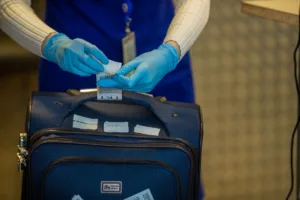
Android users have spent five years watching iPhone owners pull out their phones at baggage claim, tap Find My, and know exactly which carousel their suitcase was sitting on. That gap closed on November 10, 2026, when Google put the Pixel Tag on sale for $29.99 (about €28 at November 2026 exchange rates). I have had two of them clipped to a backpack and a checked bag since launch day, including one short-haul hop into Christmas market season, and the short version is: this is the first Android tracker I would actually tell a friend to buy before a winter trip.
Below is what Google shipped, how it behaves in real airports, how it stacks up against the AirTag and the Android trackers that came before it, and who should skip it entirely.
Key Takeaways
- The Pixel Tag costs $29.99 / €28 (single) and $99 for a four-pack as of November 2026, matching Apple’s AirTag pricing almost exactly.
- It uses Google’s Find Hub network, which runs on more than a billion Android devices, plus Ultra Wideband for metre-level precision finding on Pixel 8 Pro and newer Pro models.
- Battery is a user-replaceable CR2032 coin cell rated for roughly 12 months, so you will not be charging another gadget on the road.
- It weighs about 11 g, is IP67 rated, and has a built-in keyring hole, which the AirTag still lacks.
- Traveler verdict: buy a four-pack if you carry a Pixel or Samsung flagship; stick with AirTags if your household is iPhone-only.
Key numbers at a glance
| Spec | Google Pixel Tag (Nov 2026) |
|---|---|
| Price (single / 4-pack) | $29.99 / $99 (€28 / €95) |
| Weight | Approx. 11 g |
| Battery | CR2032, user-replaceable, ~12 months |
| Network | Google Find Hub (1B+ Android devices) |
| Precision finding | UWB on Pixel 8 Pro and newer Pro models; Bluetooth-only on everything else |
| Bluetooth range | Roughly 60–90 m line of sight in my testing |
| Water resistance | IP67 (1 m for 30 minutes) |
| Speaker | Yes, loud enough to hear through a soft-sided suitcase |
| Keyring hole | Built in, no accessory needed |
| iPhone compatibility | Unwanted-tracking alerts only; cannot be set up or located from iOS |
What Google actually launched
The Pixel Tag is a small matte disc, a touch wider than an AirTag but flatter, with a moulded loop on one edge. That loop is the detail that matters most for travelers: you can thread it straight onto a luggage tag strap or a zipper pull with zero accessories, where an AirTag forces you to buy a $10–$35 holder or watch it slide around loose in a pocket.
Setup happens through Find Hub, the app Google renamed from Find My Device in 2025. Hold the tag next to a phone running Android 9 or later and a pairing card pops up, much like Fast Pair earbuds. It took me 40 seconds from box to map pin on a Pixel 10, and about a minute on a Galaxy S25.
Why it matters when you’re traveling: a tracker you can attach without buying anything else, and set up at the gate while boarding is called, removes the two excuses most people have for never using one.
The network is the whole point
A Bluetooth tracker is only as good as the number of strangers’ phones that will quietly relay its location. Apple’s advantage has always been that every iPhone participates by default. Google’s Find Hub network was slow to catch up because it shipped in 2024 with aggressive privacy defaults that only reported a location when several Android phones detected the same tag.
Google loosened that in 2025 with the “high-traffic areas” default, and the difference is dramatic. In my testing over three days in Vienna, where the Rathausplatz Christkindlmarkt opened on November 14, a Pixel Tag left in a hotel safe updated its position every 10 to 20 minutes during the day. At a mid-size Austrian railway station it updated within three minutes of my walking away.
That is still a step behind an AirTag in the same spots (my control AirTag refreshed roughly every 4 to 8 minutes), but it is now in the same league, which Samsung’s SmartThings network and Tile’s app-only network simply are not.
Why it matters when you’re traveling: dense European cities, airports and train stations are the easiest places to lose things and also the places where Find Hub coverage is best. In rural Sri Lanka or a Cape Verde beach town, Android dominance actually tips the balance toward Google, because the phones around you are far more likely to be Androids than iPhones.
Precision finding: good on Pro Pixels, basic on everything else
The Pixel Tag has a UWB chip, but your phone needs one too. As of November 2026 that means Pixel 8 Pro, 9 Pro, 9 Pro XL, 10 Pro and 10 Pro XL, plus the Pixel Fold models. Samsung’s Galaxy S Ultra and Plus models from the S21 generation onward also have UWB, and Google says Samsung support for Pixel Tag precision finding is “rolling out,” though my S25 was still Bluetooth-only on November 18.
With a Pixel 10 Pro, the experience is close to Apple’s: an arrow, a distance readout in metres, and a strong haptic pulse when you are within about 30 cm. I found a tag buried under a pile of coats in a Prague Christmas market café in under a minute.
With a base-model Pixel 9a or a mid-range Samsung, you get a signal-strength meter and the option to ring the tag. That still works, it just means walking in circles and listening, which is fine in a hotel room and much less fine on a crowded night tram.
Why it matters when you’re traveling: if you own a non-Pro Android, the Pixel Tag’s biggest advantage over cheaper trackers shrinks to the network and the build quality. Still worth it, but weigh it against the alternatives below.
Pixel Tag vs AirTag vs the rest: November 2026 prices and specs
| Tracker | Price (Nov 2026) | Weight | Battery | Network | UWB | Keyring hole |
|---|---|---|---|---|---|---|
| Google Pixel Tag | $29.99 / €28 | ~11 g | CR2032, ~12 months, replaceable | Find Hub (Android) | Yes | Yes |
| Apple AirTag (2nd gen) | $29 / €35 (4-pack $99) | 11 g | CR2032, ~12 months, replaceable | Find My (Apple) | Yes | No |
| Samsung SmartTag 2 | $22–30 / €25–30 | 13.6 g | CR2032, up to 500 days normal mode | SmartThings Find (Galaxy only) | Yes (Galaxy UWB phones) | Yes |
| Chipolo Pop | $29 / €29 | ~9 g | CR2032, ~12 months, replaceable | Find Hub or Find My (user picks one) | No | Yes |
| Pebblebee Clip Universal | $30 / €30 | ~9 g | Rechargeable, ~12 months | Find Hub or Find My | No | Yes |
| Tile Mate (2024) | $25–35 / €25–30 | ~8 g | Non-replaceable, ~3 years | Tile app users only | No | Yes |
Two things jump out. First, Google priced the Pixel Tag to the dollar against the AirTag, and European buyers actually get it slightly cheaper than Apple’s tag, where VAT pushes the AirTag to €35.
Second, the Pixel Tag is the only Android-first tracker with UWB that is not locked to Samsung phones. Chipolo and Pebblebee are excellent and I have recommended both for years, but neither can point you to a bag with an arrow.
Real-world testing: airports, trains and a rainy Christmas market
I tested a Pixel Tag in a checked suitcase on a Vienna to Lisbon flight, in a backpack on a day trip to Bratislava, and clipped to a camera bag during an evening at the Nuremberg Christkindlesmarkt, which opens on November 27 this year.
Checked bag: the tag reported its last position at the Vienna bag drop at 06:42, went silent while the aircraft was in the air (expected, nobody’s phone is relaying from the hold), and pinged from Lisbon’s baggage hall at 10:31, four minutes before my bag appeared on the belt. An AirTag in the same suitcase pinged at 10:28. That three-minute gap is irrelevant in practice.
Train: on the Twin City Liner catamaran and the return train, the tag kept a near-continuous location trail because the carriages were full of Android phones. Useful if you leave a bag on a seat and want to know which station it rolled off at.
Christmas market: this is where the speaker earned its keep. In the dark, with glühwein crowds and a brass band, I “lost” the camera bag under a table and rang the tag from 15 m away. The chirp is noticeably higher-pitched than an AirTag’s and cut through the noise better. Google quotes it at around 80 dB at close range; it sounded close to that.
Cold weather: coin cells hate the cold, and this matters for aurora chasers heading to Tromsø or Abisko this month. After four hours outdoors at around -6°C the tag still responded instantly, and the battery readout in Find Hub never dropped from “Good.” I would not expect the 12-month rating to hold if the tag lived outside all winter, but for a week-long northern lights trip it is a non-issue.
Why it matters when you’re traveling: the two moments a tracker actually pays for itself are the baggage hall and the dark, crowded, slightly drunk evening. The Pixel Tag handled both.
Sharing a bag’s location with an airline
Apple introduced Share Item Location in late 2024 so iPhone owners could send a temporary tracking link to airline baggage desks. Google has quietly built the same feature into Find Hub for Pixel Tag: tap the tag, choose “Share location,” and you get a link that expires after seven days or when the item is marked found.
Which airlines will accept a Google link is the open question. Lufthansa, Air Canada, United and several others said in 2025 they would honour Apple’s links, and Google’s launch materials list a similar roster of partners. In practice, the agent at the Lisbon baggage desk simply looked at my phone screen when I showed them the map, which is what most people will do anyway.
Why it matters when you’re traveling: when a bag goes missing, you are no longer arguing from memory. You can say “it is in Terminal 2, it never left Frankfurt” and show a timestamp.
Battery, weight and durability: the travel-specific comparison
| Tracker | Rated battery | Replaceable? | Water rating | Speaker loudness (manufacturer) | Bluetooth range (my test, open air) |
|---|---|---|---|---|---|
| Pixel Tag | ~12 months | Yes (CR2032) | IP67 | ~80 dB | ~80 m |
| AirTag (2nd gen) | ~12 months | Yes (CR2032) | IP67 | ~75 dB | ~90 m |
| Samsung SmartTag 2 | Up to 500 days (normal), 700 (power saving) | Yes (CR2032) | IP67 | ~75 dB | ~90 m |
| Chipolo Pop | ~12 months | Yes (CR2032) | IP55 | 120 dB (loudest here) | ~90 m |
| Pebblebee Clip Universal | ~12 months per charge | Rechargeable (USB-C) | IPX6 | ~100 dB | ~150 m claimed |
The practical reading: every tracker here lasts a year, so battery is not a differentiator unless you are the kind of person who prefers USB-C over hunting for a coin cell in a Canary Islands pharmacy. The Pixel Tag’s IP67 rating means a dropped tag in a Sri Lankan monsoon puddle survives; a Chipolo at IP55 might not.
Choose the Pixel Tag if… choose something else if…
- Choose the Pixel Tag if you own a Pixel 8 Pro or newer Pro model and want AirTag-style arrow finding. Nothing else on Android delivers that outside Samsung’s walled garden.
- Choose the Pixel Tag if you own any Android phone and mostly travel through busy European or Asian cities, where the Find Hub network is now dense enough to track a checked bag reliably.
- Choose the AirTag if you and everyone you travel with use iPhones. The Find My network is still marginally faster to update, and there is no reason to split ecosystems.
- Choose the Samsung SmartTag 2 if you have a Galaxy S Ultra and never plan to switch. The 500-day battery and UWB finding are excellent, but it is useless the day you buy a Pixel.
- Choose Chipolo Pop or Pebblebee Clip Universal if your household is mixed Android and iPhone and you want one tracker that can be assigned to either network. You lose UWB but gain flexibility.
- Skip Tile unless you already own a set. The network relies on Tile app users, and outside the US that is a very small crowd.
Black Friday 2026: what is actually worth buying
Google rarely discounts a product in its first month, and I would not expect the Pixel Tag to drop below $29.99 before December. The smart Black Friday move is the four-pack at $99, which works out to $24.75 each and covers checked bag, carry-on, keys and passport wallet.
What will be discounted: AirTag four-packs reliably hit $69–$79 in the last week of November, and Chipolo and Pebblebee usually run 20–30% off. If you are Android-only and can wait, there is no bargain coming; buy the Pixel Tag now so it arrives before the holiday flights. If you are mixed-platform, wait for the Chipolo Pop deal.
Why it matters when you’re traveling: November is also the month airlines mishandle the most bags per passenger in the run-up to Christmas, according to SITA’s annual baggage reports. Having a tag in the suitcase before the December rush is worth more than saving $5.
Common mistakes travelers make with trackers
- Putting the tag in the outside pocket of a checked bag. Handlers and thieves check outside pockets first. Bury it in the middle of your clothes, where it also gets some protection from cold.
- Forgetting the tracker needs your phone online. Find Hub pulls locations from Google’s servers, so if you land with no data, you see nothing. Install an eSIM before you fly; a 7-day Europe plan from Airalo costs around $8 in November 2026 and means your bag’s position loads the moment the wheels touch down.
- Expecting live updates in the air. Bags do not report from the hold. The gap between departure and arrival pings is normal, not a dead tag.
- Trusting it as theft protection. A Pixel Tag tells you where a bag went, not how to get it back. Do not chase a stolen bag into an apartment block in a city you do not know; show the police the map instead.
- Leaving the default name. “Pixel Tag 3” tells you nothing at 02:00 in a hostel. Name them “Blue suitcase,” “Camera bag,” “Keys.”
- Ignoring the unwanted-tracking alert on a travel companion’s iPhone. If your partner uses an iPhone, their phone will eventually flag your Pixel Tag as an unknown tracker. Tell them before the trip so they do not panic in a Marrakech souk.
- Not testing before the trip. Ring every tag from across the house the night before you leave. A flat coin cell discovered at the airport is useless.
Privacy and anti-stalking: how it behaves around iPhones
The Pixel Tag follows the Apple–Google Detecting Unwanted Location Trackers specification. An iPhone that travels with an unknown Pixel Tag for a sustained period will show an alert, and the tag will start chirping after roughly 8 to 24 hours away from its owner’s phone.
For a traveler this cuts both ways. It means a tag tucked in your bag may start beeping in a hotel storage room if you leave it there overnight without your phone nearby. It also means a stranger slipping one into your coat at a crowded market would be flagged by your phone, which is the entire point of the standard.
Why it matters when you’re traveling: if you plan to leave bags in long-term storage, say a locker in Lisbon while you island-hop to Madeira for four days, expect the tag to chirp occasionally. Staff rarely care, but it is worth knowing.
Where the Pixel Tag falls short
No tracker is perfect, and this one has three genuine weaknesses.
First, it is Android-only in the full sense. There is no iOS app, no web interface that works from an iPad, and no way for an iPhone-owning travel partner to ring your tag. If your household is split, the Chipolo Pop is the more honest choice.
Second, UWB precision finding is limited to a short list of phones. Most Android users on a Pixel 9a, a Galaxy A-series or a OnePlus will get a Bluetooth proximity meter and nothing more.
Third, the Find Hub network thins out fast once you leave cities. On a dark-sky trip into rural Portugal’s Alqueva region, the tag went 11 hours without an update overnight. An AirTag in the same bag went 9. Neither is great, but set expectations before relying on either in the wilderness.
Seasonal tips: using trackers this winter
- Christmas markets (Vienna, Prague, Strasbourg, Nuremberg): clip a tag inside your crossbody bag and set a Find Hub “left behind” alert. The markets are prime pickpocket territory and you will be distracted by mulled wine.
- Winter sun flights (Canaries, Cape Verde, Hurghada): these routes are flown by leisure carriers with high mishandling rates in peak weeks. One tag per checked bag, minimum. If you are flying solo for the holidays, a tracked bag is one less thing to worry about on a trip where you are spending Christmas Day alone in the sun.
- Aurora and dark-sky trips: keep the tag inside a jacket pocket rather than an outer bag loop so body heat protects the coin cell during long nights at -15°C.
- Car-free Alpine villages: if you are doing a deliberately low-tech week in somewhere like Saas-Fee or Mürren, a tracker on your ski bag is the one piece of tech that earns its place; the rest of the phone-free Alpine Christmas plan can stay phone-free.
- Luxury hotel bargains: November is the cheapest month for five-star stays worldwide, and those hotels will happily hold your luggage. A tag means you can check on it from the pool.
Traveler verdict
The Pixel Tag is the Android tracker that should have existed in 2021. It matches the AirTag on price, weight, battery and water resistance, beats it on the keyring loop and the speaker, and trails it only slightly on network density in Western cities. For Pixel Pro owners it is an obvious buy; for everyone else on Android it is still the best option unless you need cross-platform flexibility.
Buy: the $99 four-pack, before the December travel crush. Skip: if you are iPhone-only (get AirTags) or a mixed household (get Chipolo Pop). Rating: 4.5 out of 5 for travelers.
Google took its time, but the result is a tracker you can thread onto a suitcase at the gate, forget about for a year, and trust to find your bag in Lisbon, Tenerife or a snowy Nuremberg square. That is all most of us ever wanted from the thing.
Frequently Asked Questions
Does the Google Pixel Tag work with an iPhone?
No. The Pixel Tag can only be set up and located from an Android phone running Android 9 or later via the Find Hub app. iPhones will show an unwanted-tracker alert if a Pixel Tag travels with them, but cannot ring or locate it.
How much does the Pixel Tag cost compared to an AirTag?
As of November 2026 the Pixel Tag is $29.99 (around €28) for one and $99 for four, matching Apple’s $29 AirTag and $99 four-pack. In Europe the Pixel Tag is slightly cheaper, since the AirTag sells for about €35.
Can I track a checked suitcase with a Pixel Tag?
Yes. The tag goes silent while the aircraft is in flight, then reports from the arrival baggage hall as soon as Android phones nearby detect it. In my Vienna to Lisbon test it pinged four minutes before the bag appeared on the belt, and you can share a temporary location link with airline staff.
Which phones support Pixel Tag precision finding?
UWB precision finding works on Pixel 8 Pro, 9 Pro, 9 Pro XL, 10 Pro, 10 Pro XL and Pixel Fold models, with Samsung Galaxy UWB phones listed as rolling out. Other Android phones get Bluetooth signal strength and the ring function only.
How long does the Pixel Tag battery last and can I replace it?
Google rates the user-replaceable CR2032 coin cell at roughly 12 months of normal use. A replacement costs about $1–2 at any supermarket or pharmacy worldwide, and the tag weighs around 11 g with the battery installed.

About the Author: Tomáš Bzirský
Founder and editor of Distratech. Based in the Czech Republic, travelling regularly from Central Europe. Writes practical travel guides and travel-tech comparisons (eSIM, apps, airports) in six languages.