The Danube Cycle Path from Passau to Vienna is beginner-friendly by European cycling standards: mostly flat, consistently signposted and packed with riverside inns. The catch is distance—roughly 327 km—so a six-day itinerary works best if you hire a reliable bike, transfer your luggage and treat the final 80 km as a flexible stage rather than a test of character.
Key Takeaways
- Allow six cycling days for approximately 327 km, averaging 40–60 km daily except for the 80 km Krems–Vienna finale.
- Touring-bike hire typically costs €95–€140 per trip, while e-bikes cost about €195–€260 as of September 2026.
- Budget €15–€20 per bag per cycling day for luggage transfers, or book a package that includes them.
- September is the sweet spot: expect roughly 12–22°C, fewer summer crowds and the Wachau wine harvest.
- First-timers should ride downstream from Passau to Vienna and use the Krems–Tulln train shortcut if the final stage feels too long.
Key Numbers at a Glance
| Trip detail | Recommended figure | Why it matters |
|---|---|---|
| Total cycling distance | Approximately 327 km | Route-bank choices can change the total by 5–15 km |
| Cycling days | 6 | Four days feels rushed; seven is genuinely leisurely |
| Daily riding time | 3–6 hours | Based on 15–18 km/h including short pauses |
| Total climbing | Roughly 700–1,000 metres | Most individual climbs are short |
| Bike hire | €95–€260 | Touring bike versus e-bike, September 2026 rates |
| Luggage transfers | €75–€120 per bag | Five hotel-to-hotel transfers over six riding days |
| Suggested daily budget | €145–€220 per person | Sharing a room, excluding flights |
| Best months | May, June and September | September is warmer than October but quieter than August |
Prices in this guide are typical published or directly bookable rates checked in September 2026. Hotel, train and package prices vary by date, room demand and cancellation terms.
Step 1: Decide Whether Six Days Is Right for You
Six days is the practical middle ground between a sporty four-day ride and a relaxed seven- or eight-day holiday. You will have time for Melk Abbey, Linz and Wachau wine stops, but Day 6 is long unless you use the train shortcut.
A moderately active beginner on a touring bike should expect an average moving speed of 15–18 km/h. An e-bike usually raises that to 19–22 km/h, although café stops, ferries and photographs matter more than raw speed.
| Format | Daily average | Best for | Trade-off |
|---|---|---|---|
| 4 cycling days | 80–85 km | Fit road cyclists | Little sightseeing time |
| 6 cycling days | 54–55 km | Active first-timers | One 80 km final day |
| 7 cycling days | 46–47 km | Families and casual riders | One extra hotel night |
| 8 cycling days | 40–41 km | Slow travel and winery visits | Higher accommodation cost |
A clear decision framework
- Choose a standard touring bike if you can comfortably ride 50 km at home, dislike charging logistics and want the lowest price.
- Choose an e-bike if this is your first multi-day ride, you are travelling as a mixed-ability couple or you want to complete the full 80 km final stage.
- Choose an all-inclusive cycling package if you value one booking, emergency support and guaranteed luggage collection.
- Choose independent bookings if you want specific hotels, plan to stay in wineries or are willing to coordinate six properties.
- Choose seven days instead if 60 km already sounds ambitious; six days is beginner-manageable, not completely effortless.
My verdict: hire an e-bike if your preparation consists of occasional weekend rides. The typical €100–€130 premium is cheaper than adding an emergency hotel night or spending the Wachau watching your battery percentage—and your partner’s patience—decline.
Step 2: Book Bike Hire and Luggage Transfers
One-way rental is far better than bringing your own bicycle for a first trip. A boxed bike can cost €50–€100 each way on a flight, while many trains require a bicycle reservation and offer only a handful of spaces.
Established operators include Donau Touristik, Eurobike and OÖ Touristik. Their Passau–Vienna packages generally include accommodation, breakfast, luggage transfer, route material and a service hotline.
| Option | Touring bike | E-bike | Luggage handling | September 2026 price basis |
|---|---|---|---|---|
| Donau Touristik rental/add-on | From about €99 | From about €209 | Included in most hotel packages | Per trip; model and package dependent |
| Eurobike rental/add-on | From about €99 | From about €239 | Included in organised tours | Per person; availability dependent |
| Independent local rental | €18–€28 per day | €35–€50 per day | Usually not included | Six days can cost €108–€300 |
| Bring your own bike | €0 rental | €0 rental | Not included | Airline and rail fees often total €100+ |
Ask three questions before paying: Is Vienna drop-off included? Does the e-bike come with a second battery or a charger? Is puncture assistance included outside office hours?
Most rental fleets use upright hybrid bikes with 21–27 gears, a rear pannier, lock and repair kit. Helmets may cost another €10–€25 per trip, and Austrian law does not require adults to wear one—but skipping it to save €15 is a bad trade.
How luggage transfer works
You leave one tagged suitcase at hotel reception, usually by 09:00. The driver delivers it to the next property around 15:00–17:30, so carry rain gear, medication, valuables and a charging cable in your pannier.
Standalone transfers generally cost €15–€20 per bag per stage, often with a 20 kg limit. Five transfers therefore cost approximately €75–€100; an organised package usually builds that amount into the total price.
Skip rolling multiple small bags. Use one soft-sided suitcase per person, because operators may charge by item rather than total weight: two 10 kg bags can cost €30 per stage versus €15 for one 20 kg bag.
Step 3: Reach Passau and Prepare the Night Before
Passau is in Germany, close to the Austrian border. The easiest gateways are Munich and Vienna, both connected by direct or one-change trains.
| Journey | Typical duration | Advance fare, September 2026 | Operator |
|---|---|---|---|
| Munich Airport–Passau | 2 hr 20 min–3 hr | From €27.99 | DB regional/ICE combinations |
| Munich Hbf–Passau | About 2 hr 10 min | From €19.99 | Deutsche Bahn |
| Vienna Hbf–Passau | About 2 hr 20 min | From €19.90 | ÖBB |
| Vienna Airport–Passau | 2 hr 50 min–3 hr 30 min | From €24.90 | ÖBB, usually one change |
A Munich Airport taxi to Passau takes roughly two hours but can exceed €300, compared with around €28 by train. Unless four cyclists are sharing a pre-booked van, take the train.
Arrive one night before cycling. A late flight followed by bike fitting and 42 km in the saddle is how beginners discover knee pain before reaching Austria.
Hotel Residenz Passau, on the riverfront, is my practical choice at roughly €125–€175 for a double with breakfast. It places you about a 20-minute walk from Passau Hauptbahnhof but close to the old town and the next morning’s path.
Collect the bike no later than 16:00 if possible; many rental desks close between 17:00 and 18:00. Test both brakes, saddle height, lights, battery key and pannier clips before the staff disappear.
Step 4: Follow This Six-Day Passau-to-Vienna Route
The route follows the German and Austrian Donauradweg, also marked as EuroVelo 6 and, in Upper Austria, R1. It is mostly paved or hard-packed and largely traffic-free, but riverside construction and flood closures can force short diversions.
| Day | Stage | Distance | Riding time | Difficulty |
|---|---|---|---|---|
| 1 | Passau–Schlögen | 42 km | 2.5–3.5 hr | Easy |
| 2 | Schlögen–Linz | 54 km | 3.5–4.5 hr | Easy |
| 3 | Linz–Grein | 60 km | 4–5 hr | Moderate |
| 4 | Grein–Melk | 51 km | 3.5–4.5 hr | Easy–moderate |
| 5 | Melk–Krems | 40 km | 3–5 hr with stops | Easy |
| 6 | Krems–Vienna | 80 km | 5–6.5 hr | Long but flat |
Day 1: Passau to Schlögen — 42 km
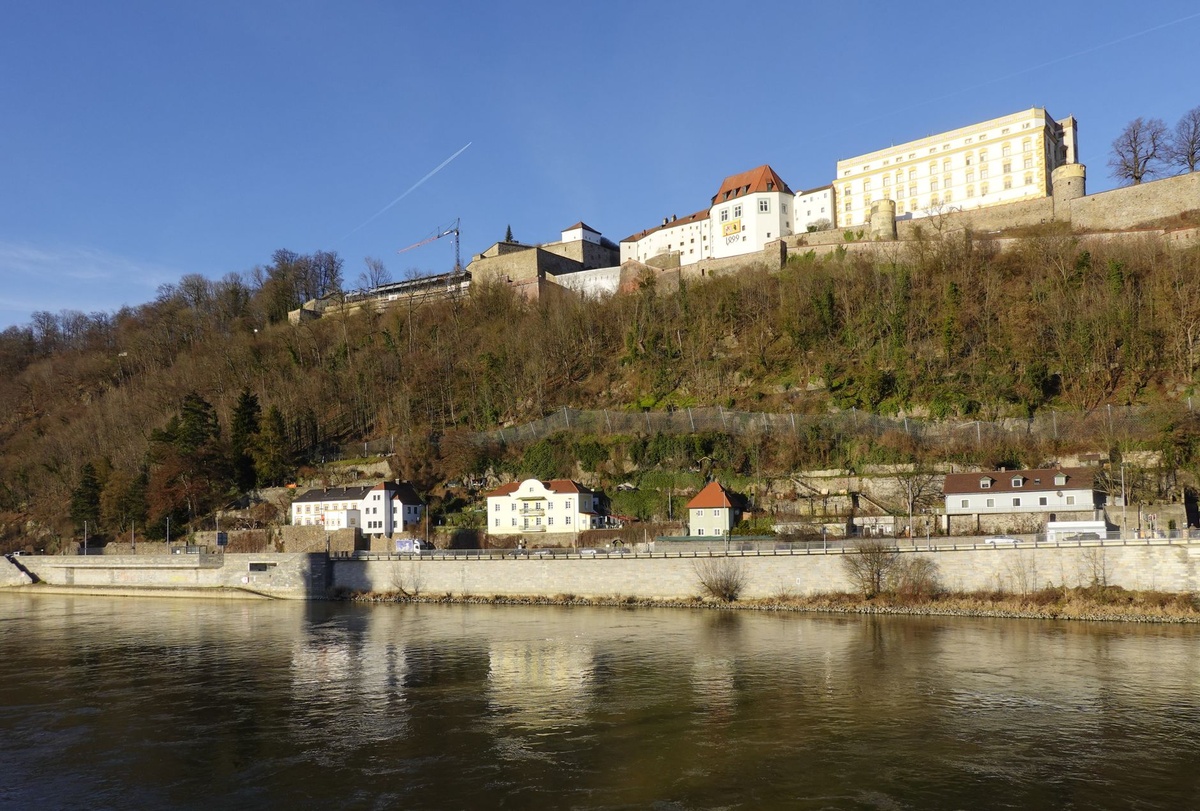
Leave Passau around 09:00, following the Danube east past the confluence of the Inn, Ilz and Danube. The first stage is an ideal rehearsal: almost flat, easy to navigate and roughly three hours of actual pedalling.
The small ferry near Schlögen may be necessary depending on your chosen bank and accommodation. Seasonal crossings generally cost about €3–€5 including a bicycle and typically run during daylight from April into October, but high water and bad weather can suspend service.
Stay at Riverresort Donauschlinge, where September doubles commonly run €170–€230 including breakfast and spa access. It costs about €50–€80 more than a simple guesthouse, but the riverside pool is worthwhile after your first day.
Walk to the Schlögener Blick viewpoint only if your legs still feel good: the return hike takes 60–90 minutes. Skip doing it in cycling shoes; the forest path can be slippery after rain.
Day 2: Schlögen to Linz — 54 km
The Danube Loop gives way to wooded banks, small ferries and quiet agricultural stretches. Start by 08:30 because riverside shade can make September mornings feel closer to 10°C than the afternoon’s 20°C.
Use the south-bank route toward Aschach and Wilhering for a quieter ride. The north bank is sometimes marginally shorter, but saving 3–5 km is not worth trading monastery views for busier road sections.
In Linz, visit the Ars Electronica Center if you arrive before late afternoon. Normal opening is Tuesday–Sunday, 10:00–17:00, and adult admission is around €13; Mondays are commonly closed.
Stay at Austria Classic Hotel Wolfinger on Hauptplatz, with doubles around €125–€170. Eat at Stadtliebe rather than settling for the most visible square-side tourist menu; expect €16–€24 for a main and €4.50–€5.50 for beer.
Day 3: Linz to Grein — 60 km
This is the first substantial day, though the terrain remains forgiving. Leave Linz before 09:00 and pass Steyregg, Mauthausen and the fertile Machland plain.
The Mauthausen Memorial is a serious three-hour stop, not a quick attraction. Admission is free, and the site generally opens daily from 09:00–17:30 in March through October; if you visit properly, expect to reach Grein after 17:00.
Cross-bank choices can change this stage by around 5 km. Follow official R1 diversion signs over a blindly plotted Komoot route, especially where flood-control and construction projects temporarily close the embankment.
Hotel-Gasthof Zur Traube is a solid central option at approximately €95–€135 for a double. Order the local fish or schnitzel at its restaurant for roughly €18–€25 rather than cycling farther in search of a trendier dinner.
Day 4: Grein to Melk — 51 km
The route enters the Strudengau, historically one of the Danube’s most difficult navigation stretches. Today the cycling is straightforward, but there are more undulations than on the Linz plain.
Stop in Ybbs for coffee, then continue toward Melk beneath its enormous baroque abbey. A café lunch costs around €12–€16, compared with €25–€35 for a full riverside restaurant meal that can add 90 minutes to the day.
Stay at Hotel Restaurant zur Post, where doubles usually cost €125–€175 with breakfast. Its secure bike room and central location matter more than a distant wellness hotel with a marginally better river view.
If you arrive by 15:30, visit Melk Abbey that afternoon. September opening is generally around 09:00–17:30, with last admissions earlier; adult entry is approximately €17.50–€19 depending on the tour format.
Day 5: Melk to Krems through the Wachau — 40 km
This is the shortest stage and the one you should deliberately make slow. September brings grape harvests, warm afternoons and fewer river-cruise crowds than July, making it arguably the best month of the year for the Wachau.
Ride the north bank through Spitz, Weißenkirchen and Dürnstein. The south bank is quieter, but the north side has the region’s best concentration of villages, wine taverns and vineyard views.
Allow five hours for a route that requires barely three hours of pedalling. A bicycle ferry between banks generally costs €3–€5, while a scheduled Danube boat with a bicycle can cost €20 or more and runs less frequently in shoulder season.
For lunch, choose a Heuriger displaying a pine branch or “Ausg’steckt” sign. A cold plate and quarter-litre of Grüner Veltliner costs roughly €15–€22; check the regional wine-tavern calendar, because family-run venues rotate opening weeks.
Stay at Hotel Unter den Linden in Krems, usually €120–€165 for a double. Avoid a heavy multi-course dinner: Day 6 is twice as long as Day 5.
Day 6: Krems to Vienna — 80 km, or 38–55 km with a train shortcut
The full ride follows the Danube past Traismauer, Tulln and Klosterneuburg into Vienna. It is flat but exposed, and a 20 km/h headwind can turn five hours of riding into seven.
For the full route, leave by 08:00 and aim to reach Tulln—about 40–43 km—by lunch. Café stops after Tulln become less scenic, so bank your time early.
The sensible beginner alternative is a regional train from Krems to Tulln, taking about 40–50 minutes and costing roughly €12–€18 plus a bicycle ticket. Cycle the final 38–40 km from Tulln to Vienna, preserving the satisfying riverside arrival without grinding through 80 km.
A second option is to cycle Krems to Traismauer or Tulln, then take the train into Vienna. Check bicycle symbols and capacity in the ÖBB app; regional trains accept bikes when space permits, whereas long-distance services often require reservations.
Finish around Prater or Donaukanal, depending on your rental return point. Motel One Wien-Prater is convenient for the river path, U-Bahn and many bike depots, with September doubles commonly around €115–€165.
Step 5: Navigate, Charge and Stay Connected
Use official signs as your primary navigation and an offline app as backup. Komoot is better for turn-by-turn cycling and surface detail, while Organic Maps is free and excellent for offline hotels, supermarkets and train stations.
Download the route before leaving Wi-Fi. Continuous screen navigation can consume 30–50% of a modern phone battery in five hours, compared with roughly 10–20% when the screen stays off and voice prompts are enabled.
- Install ÖBB for Austrian trains, platforms and bicycle availability.
- Install DB Navigator for travel to Passau and German rail disruptions.
- Use Komoot for the planned track, but obey physical closure signs.
- Use Windy or Windfinder to check headwinds before the 80 km finale.
- Carry a 10,000 mAh power bank; it usually provides about two complete phone charges.
- Save hotel phone numbers and luggage tags as offline screenshots.
Germany and Austria are both covered by EU roaming for qualifying European plans. Travellers arriving from outside Europe can use an eSIM, but compare the price carefully: a 5–10 GB regional plan usually costs €12–€25, while hotel Wi-Fi plus offline maps costs nothing.
Before leaving home, put lights or plugs on a timer rather than leaving everything permanently switched on. Distratech’s guide to controlling smart-home devices while travelling explains the convenience and security trade-offs, although remote access should always use multi-factor authentication.
Where September Helps—and Where It Does Not
September is shoulder-season gold on this route. Typical daytime highs sit around 18–22°C, versus 25–30°C during hot July spells, while morning lows of 9–13°C make a light jacket essential.
Accommodation is often 10–20% cheaper than peak summer in smaller Danube towns, but Vienna can be the exception because conferences and city events push fall rates above August weekends. Book Vienna first, then build the cycling nights backward.
Early September offers longer daylight and a better ferry schedule. Late September delivers quieter paths and active grape harvests, but sunset moves toward 18:45–19:00 and seasonal ferries may reduce hours.
Pack for rain rather than cold. A breathable jacket and waterproof shoe covers together cost less and pack smaller than heavy waterproof trousers, though September showers can still produce a full wet day.
Sample Budget for a Six-Day Ride
This budget assumes two travellers sharing double rooms, one pre-ride night in Passau, six riding-stage nights including Vienna and breakfast at most hotels. It excludes flights and the night after your Vienna finish if you extend the stay.
| Expense | Per person, touring bike | Per person, e-bike |
|---|---|---|
| Seven hotel nights, shared doubles | €525 | €525 |
| Bike rental | €110 | €225 |
| Five luggage transfers | €90 | €90 |
| Lunches, dinners and drinks | €270 | €270 |
| Ferries and local transport | €25 | €25 |
| Attractions | €40 | €40 |
| Train to Passau | €25 | €25 |
| Contingency | €75 | €75 |
| Estimated total | €1,160 | €1,275 |
A comparable organised package generally starts around €850–€1,200 per person before dinners and transport to Passau. Independent booking can save €100–€250, but only if you secure rooms early and avoid expensive one-night cancellation rates.
Do not choose an awkward hotel 5 km uphill to save €20. Over six nights, convenient riverside accommodation is worth more than one fancy Vienna dinner—and may prevent an extra taxi costing €20–€35.
Common First-Timer Mistakes
- Underestimating the last day. Krems–Vienna is almost double the Wachau stage; decide before breakfast whether you are riding 80 km or using the train.
- Overpacking the pannier. Carry 3–5 kg, not a daypack stuffed with 10 kg; luggage transfer exists to protect your shoulders and hands.
- Following GPS over closure signs. Flood barriers and path works change routes faster than mapping databases update.
- Starting with a low saddle. A saddle several centimetres too low feels safe for ten minutes but can cause knee pain after 40 km.
- Assuming every ferry runs all day. Some stop for lunch, finish before dusk or suspend service during high water.
- Booking restaurants too late. Village kitchens may close by 20:00–21:00, earlier than urban travellers expect.
- Drinking too much in the Wachau. Austria’s general cycling alcohol threshold is not a holiday target; taste modestly and finish riding before a serious winery session.
- Forgetting cash. Carry €30–€50 because small ferries, taverns and farm stands may not accept cards.
The most expensive mistake is confusing “flat” with “effortless.” Six days of repeated saddle time creates hand, neck and seat discomfort even when elevation is minimal; one 30–40 km training ride each weekend for a month makes a bigger difference than buying premium cycling clothes.
The Verdict: Ride Downstream, Transfer the Bag, Keep Day 6 Flexible
For a first Danube ride, the winning formula is simple: arrive in Passau one day early, rent an e-bike or well-fitted hybrid, send your suitcase ahead and reserve riverside hotels before September harvest demand tightens availability.
Do not sacrifice the Wachau to prove you can cover every kilometre. Ride slowly through the vineyards, check the wind in Krems, and use the Tulln train shortcut if necessary—the best version of this journey ends with energy for Vienna, not an argument with your bicycle.
Save this itinerary, request bike and luggage quotes from at least two operators, and book the Vienna room first. Once those three pieces are secured, the Danube does most of the route planning for you.
Frequently Asked Questions
How many days do you need to cycle from Passau to Vienna?
Six cycling days covers the approximately 327 km route at a manageable 40–60 km most days, followed by an 80 km finale. Seven days is better for very casual riders because it reduces the daily average from about 55 km to 47 km.
How much does it cost to cycle the Danube from Passau to Vienna?
Budget approximately €1,160 per person with a touring bike or €1,275 with an e-bike, based on two people sharing rooms in September 2026. Organised packages typically start around €850–€1,200 before dinners and travel to Passau.
Is the Passau-to-Vienna Danube Cycle Path suitable for beginners?
Yes, provided you can ride 40–60 km per day and use luggage transfers. The route is mostly flat and well signposted, but the full Krems–Vienna stage is 80 km, so beginners should consider taking the train to Tulln and cycling the final 38–40 km.
When is the best month to cycle from Passau to Vienna?
September offers the best balance of 18–22°C afternoons, lighter crowds and Wachau wine harvest activity. Early September has longer daylight and more reliable ferry timetables than the final week of the month.
Should I rent an e-bike for the Danube Cycle Path?
Rent an e-bike if you have not completed several 50 km training rides or want to ride the full 80 km final day. Expect to pay roughly €195–€260 per trip, about €100–€130 more than a standard touring bike.

About the Author: Tomáš Bzirský
Founder and editor of Distratech. Based in the Czech Republic, travelling regularly from Central Europe. Writes practical travel guides and travel-tech comparisons (eSIM, apps, airports) in six languages.