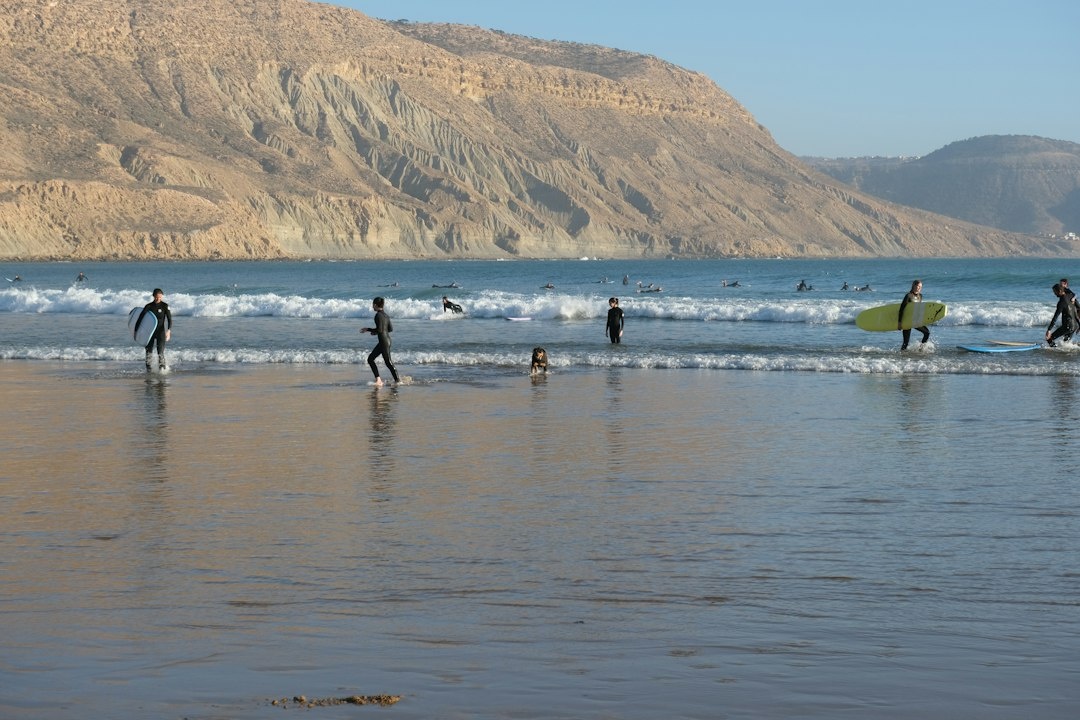
Taghazout in October is the sweet spot almost nobody books properly. The Atlantic swell has just switched back on after the flat summer, the water is still 21–22°C, the November crowd of European wetsuit-wearers hasn’t landed yet, and a two-hour group surf lesson with board and wetsuit still costs €15–€20 if you walk in off the street instead of pre-paying for a camp from your sofa in Manchester.
I’ve done it both ways — one week in a surf camp, one week freelancing lessons from hostels in Tamraght — and most first-timers overpay by €150–€250 because they don’t know the second option exists. This guide fixes that, with a day-by-day two-week plan, every price in euros as of October 2026, and the beginner breaks from Devil’s Rock northwards ranked by how forgiving they are when you’re still falling off.
Key Takeaways
- Standalone group lessons in Taghazout and Tamraght cost €15–€25 for two hours including board and wetsuit; private lessons run €30–€35 (October 2026).
- A budget surf camp week (dorm, breakfast, dinner, 5 lesson days, gear) costs €280–€420; the same week freelanced from a hostel costs €200–€260.
- The best beginner breaks are Devil’s Rock, Banana Beach and Crocro, all within 7 km south of Taghazout and reachable by the 8 MAD (€0.75) number 32/33 Alsa bus.
- October water is 21–22°C, so a 3/2 wetsuit in the morning and a rash vest by midday is enough — don’t buy a 4/3.
- Realistic 14-day all-in budget flying from Europe: €680–€880 including flights, 8 lesson days, food and a Paradise Valley day trip.
Key Numbers at a Glance (October 2026)
| Item | Cost / Figure | Notes |
|---|---|---|
| Agadir airport → Taghazout grand taxi | 300–350 MAD (€28–€32) | 45–55 min, 48 km, fixed-rate board at arrivals |
| Airport bus + local bus combo | ~30 MAD (€2.80) | 2–2.5 hours with changes in Agadir |
| Group lesson, 2 hrs, gear included | 150–250 MAD (€14–€23) | Cheaper in Tamraght than Taghazout centre |
| Private lesson, 1.5–2 hrs | 320–380 MAD (€30–€35) | Book direct, not via hostel desk |
| Softboard rental, full day | 100–150 MAD (€9–€14) | Weekly deals: 500–600 MAD (€46–€56) |
| Wetsuit rental, day | 50 MAD (€4.60) | Often thrown in with a weekly board deal |
| Hostel dorm bed | 90–160 MAD (€8–€15) | Includes breakfast at most surf hostels |
| Budget surf camp, 7 nights | €280–€420 | Half board, 5 lesson days, gear, transport to breaks |
| Tagine + mint tea | 50–70 MAD (€4.60–€6.50) | Local cafés; tourist spots charge double |
| Water temperature | 21–22°C | Air 24–28°C, sunset ~18:45 early Oct |
| Exchange rate used | €1 ≈ 10.8 MAD | Withdraw dirhams in Agadir, not Taghazout |
Step 1: Get to Taghazout Without Paying €32 for a Taxi
Ryanair and easyJet fly into Agadir Al Massira (AGA) from London, Manchester, Paris, Marseille, Brussels and a dozen German cities. For October 2026, one-way fares run €35–€90 if you book three to five weeks out; Transavia from Amsterdam and Paris Orly is usually €60–€110. Fly midweek — the Saturday rotations are where the €150 fares live.
From the airport you have three realistic options. Grand taxi: 300–350 MAD (€28–€32) for the whole car, 48 km, about 50 minutes, splittable four ways if you find people at the baggage belt. Pre-booked camp transfer: €35–€45 per car, zero haggling. Bus: the Alsa airport shuttle to Agadir (around 20 MAD / €1.85), then the Alsa 32 or 33 from the Batoir/Talborjt stops to Taghazout for 8 MAD (€0.75) — about €2.80 total, but budget two and a half hours and arrive before dark.
My verdict: split a grand taxi if you land after 15:00; take the bus if you land in the morning and want the €29 for two extra lessons. Drivers at the airport are not negotiating off the posted rate — the board says 300 MAD to Taghazout and that’s what you’ll pay.
If your Ryanair flight is delayed over three hours (it happened to me on the Stansted–Agadir route), you’re entitled to up to €400 under EU261 because the flight departs an EU airport. File through AirHelp — they take a cut but win far more often than individuals emailing Ryanair customer service.
Step 2: Choose Your Base — Taghazout Village vs Tamraght
This decision matters more than which camp you pick. Taghazout village is the famous one: the blue-and-white fishing town, the surf shops, the rooftop cafés, the Anchor Point view. Tamraght is the quieter village 5 km south, 400 m from Devil’s Rock and Banana Beach, and it’s where the better-value beginner lessons are because the beginner breaks are at the end of the street.
| Factor | Taghazout village | Tamraght |
|---|---|---|
| Dorm bed (Oct 2026) | 130–180 MAD (€12–€17) | 90–140 MAD (€8–€13) |
| Walk to a beginner break | Panorama: 5 min (small days only) | Devil’s Rock: 8–10 min |
| Group lesson price | 200–250 MAD (€18–€23) | 150–200 MAD (€14–€18) |
| Nightlife / social | Busier: rooftop bars, more backpackers | Quieter, camp dinners, earlier nights |
| Food options | 40+ cafés, tourist pricing creeping in | A dozen spots, local prices |
| Best for | Solo travellers who want a scene | Pure budget surf progression |
Opinionated call: sleep in Tamraght for week one when you need daily beginner waves, then move to Taghazout for week two when you’re ready to try Panorama and Hash Point on small days. Both villages sit on the 8 MAD bus route, so you can always spend a day in the other.
For hostels, Amayour Surf Hostel in Taghazout (dorms from around €13 with a proper breakfast and an Anchor Point rooftop view) and Lunar Surf House in Tamraght (dorms around €10, board rental on site) are the two I’d actually book. Skip anything advertising a “luxury hostel” at €25 a bed — that’s camp-level money for hostel-level service. For a wider sweep, compare hotels in Taghazout and filter by “free cancellation”, because October swell forecasts can tempt you to shift villages mid-trip.
Step 3: Surf Camp vs Standalone Lessons — The Real Numbers
This is the €200 question. Surf camps bundle accommodation, half board, lessons, gear and a van to the right break each morning. Standalone means booking a hostel, walking to a surf school and paying per lesson. Here’s what each actually costs for seven nights in October 2026.
| Cost line (7 nights, 5 lesson days) | Budget surf camp | Standalone from hostel |
|---|---|---|
| Accommodation | Included | 7 × €11 = €77 |
| Breakfast | Included | Included at hostel |
| Dinner | Included (5–7 nights) | 7 × €6 = €42 |
| Lunch | Usually NOT included | 7 × €4 = €28 |
| Group lessons (5 × 2 hrs) | Included | 5 × €17 = €85 |
| Board + wetsuit on non-lesson days | Included | 2 × €12 = €24 |
| Transport to breaks | Included (van) | Bus/shared taxi: ~€6 |
| Video analysis / theory | Usually included | Not available / €10 extra |
| Week total | €280–€420 | €200–€260 |
| Per lesson-day equivalent | €56–€84 | €40–€52 |
Named camps in that €280–€420 band for October 2026: Surf Berbere (Taghazout, dorm packages from around €290), Original Surf Morocco (Taghazout, shared rooms around €320) and Dfrost Almugar in Tamraght (around €350–€400, strong beginner programme). Surf Maroc’s Taghazout Villa and Amouage start closer to €550–€700 — great product, wrong article.
The decision framework
- Choose a surf camp if you’re solo and nervous, you’ve never stood on a board, you want someone else to read the tide chart and drive you to Imsouane, and €40–€60 extra per week for zero decision fatigue is worth it.
- Choose standalone lessons if you’re on under €50 a day, you’re comfortable asking “what time is low tide tomorrow?” at a surf shop, you want to pick your instructor after one trial lesson, and you’d rather spend the savings on Paradise Valley and a second week.
- Choose the hybrid (my recommendation): camp for week one (structure, friends, basics drilled in), standalone for week two (you now know which break works at which tide). This is exactly the plan below.
One thing camps genuinely do better: they move you. When Devil’s Rock is closing out, the van goes to Imsouane or Crocro without you lifting a finger. Standalone, you’ll need to check Surfline at 07:00 and make the call yourself — which, by day eight, you can.
Step 4: Beginner Breaks From Devil’s Rock Northwards
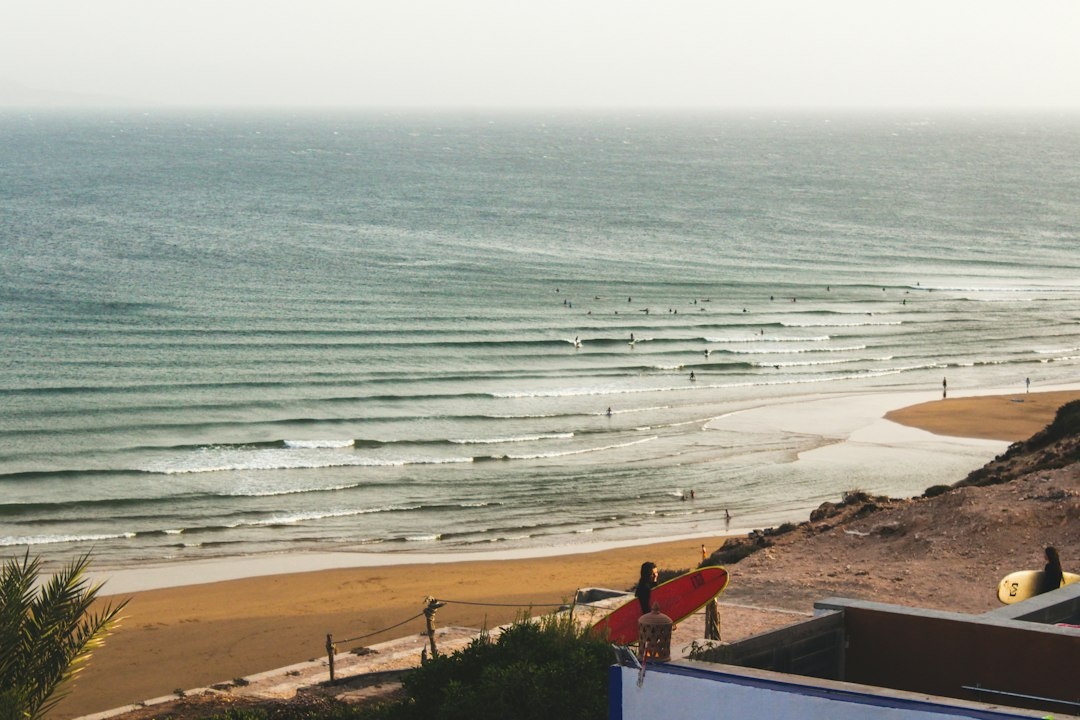
October swells around Taghazout typically run 2–5 ft (0.6–1.5 m), ideal for learning: enough push to get the board planing, rarely so big that beginner beaches close out. The key is matching the break to the tide — every surf school will tell you this, and half the hostel guests ignore it anyway.
| Break | Location / distance from Taghazout | Best tide for beginners | Why it works | Watch out for |
|---|---|---|---|---|
| Devil’s Rock | Tamraght, 5 km south | Mid to high | Long, gentle beach-break rollers; the default lesson spot | Crowded 10:00–13:00 with camps; walk 200 m north for space |
| Banana Beach | Aourir, 7 km south | Low to mid | Sheltered, softer waves; works when Devil’s is too big | Rocks on the inside at low tide — ask locals where |
| Crocro (Croco) Beach | Between Tamraght and Taghazout, 3 km | Mid | Quieter beach break, good for day 4–7 confidence | No facilities; bring water |
| Panorama | Taghazout village, 0 km | Mid to high, small swell only | Right in town; a reward for week two | Rocky bottom; rent booties (30 MAD) |
| Hash Point | Taghazout village, 0.5 km | High, under 3 ft | Mellow right-hander on small days; your first “real” wave | Gets intermediate-crowded; respect the line-up |
| Imsouane (The Bay) | 80 km north, 1 hr 20 min | Mid, incoming | Possibly the longest beginner-friendly right in Africa — 400 m rides | Day trip logistics; shared taxi ~€6–€8 each way |
Anchor Point, Killer Point and Boilers are the names on the postcards and the T-shirts. They are not for you this trip. Anchor on a 6 ft October day is a reef-and-rock point break with a paddle-out that intermediates find humbling; watch it from the Panorama cliff café with a 15 MAD mint tea instead.
Step 5: The Two-Week Plan, Day by Day
Week One — Camp in Tamraght (structure)
Day 1 (arrive): Land, split a grand taxi, check in before dinner. Withdraw 2,000 MAD at an Agadir ATM on the way if the driver will stop (Attijariwafa and BMCE charge ~30 MAD per withdrawal; UK and EU cards usually add 2–3%). Do NOT rely on the two ATMs in Taghazout — both ran dry on the Sunday I needed them.
Days 2–4: Morning lessons at Devil’s Rock, 09:00–11:30 depending on tide. Expect day two to be pop-up drills on sand and whitewater rides; by day four you should be catching unbroken knee-to-waist waves on an 8’0″–9’0″ softboard. Afternoons: nap, stretch, cheap lunch at Café Mouja in Taghazout (avocado toast 45 MAD / €4.20) or whatever the camp cook does.
Day 5 (rest day): Your shoulders will demand it. Paradise Valley is 30 km inland: a shared grand taxi from Aourir costs 50–60 MAD (€5) per person each way, versus €22–€25 for a hostel tour covering the same rock pools and a tagine lunch. Go independently, leave by 09:00, and be back for a 17:30 sunset session if you have legs left.
Days 6–7: The camp van typically runs to Banana Beach or Crocro depending on swell. If the camp offers an Imsouane day trip for €25–€35 including transport and lunch, take it — The Bay on a mid-tide October push is the single best place on this coast to link your first ten-second ride.
Week Two — Standalone from Taghazout (freedom)
Day 8 (move): Check out, then bus or walk the 5 km coastal path north to Taghazout (45 min, flat, beautiful at 08:00). Check into a hostel dorm and negotiate a seven-day softboard-plus-wetsuit deal on the main street: 550–650 MAD (€51–€60) is the going rate for a decent foamie; 800+ MAD is the tourist price, so walk 50 m to the next shop.
Days 9–11: Surf twice a day, lesson-free, at Devil’s Rock (bus back down, 8 MAD) or Crocro. Book ONE private lesson (320–350 MAD / €30–€32) on day 10 with a specific goal: fixing your stance or learning to angle the takeoff. A private at this stage is worth three group lessons in week one — you finally have enough wave count to apply the correction.
Day 12: Second rest day, or a half day. Walk up to the Anchor Point headland at 07:30 to watch the locals, then breakfast at L’Auberge on the beachfront (msemen pancakes with honey and amlou, 35 MAD / €3.25). Souk El Had in Agadir is a 45-minute bus ride and a genuine market, not a tourist bazaar — Sunday is best.
Days 13–14: If swell is under 3 ft and tide is high in the morning, try Hash Point or Panorama with a local in the water who can point out the rocks. Sunset session on day 14, dinner at Dar Josephine in Tamraght (fish tagine around 90 MAD / €8.30, the best splurge on this coast), early night, airport.
Step 6: The Full Two-Week Budget Breakdown
| Category | Hybrid plan (camp + standalone) | All standalone |
|---|---|---|
| Return flights from Europe (midweek, Oct 2026) | €90–€180 | €90–€180 |
| Airport transfers (shared taxi both ways) | €16 | €16 |
| Week 1 surf camp, dorm, half board, 5 lessons | €320 | — |
| Week 1 standalone equivalent | — | €230 |
| Week 2 hostel dorm, 7 nights | €84 | €84 |
| Week 2 board + wetsuit, 7 days | €55 | €55 |
| Week 2 one private lesson | €32 | €32 |
| Food not covered (lunches week 1, all meals week 2) | €110 | €95 |
| Paradise Valley (independent) | €14 | €14 |
| Imsouane day trip | €30 | €20 (shared taxi + lunch) |
| Local SIM / eSIM | €6 | €6 |
| Local buses, sunscreen, booties, mint tea habit | €35 | €35 |
| 14-day total | €792–€882 | €677–€767 |
| Daily average excluding flights | €50 | €42 |
For comparison, the same two weeks in Portugal’s Ericeira or Peniche in October runs €1,100–€1,400 with lessons at €35–€45 each, and Bali’s Canggu is similar once you add the long-haul flight. Taghazout is the cheapest place in the Northern Hemisphere to learn to surf properly in October, and it’s not close.
Step 7: Gear, Weather and What to Pack
October water is 21–22°C in the first half of the month, drifting to 20°C by Halloween. Camps hand out 3/2 full suits; a shorty or boardshorts plus a long-sleeve rash vest is fine from 11:00 onwards. Do not buy a 4/3 wetsuit for this trip — that’s a €150 mistake I watched three people make last year.
Air temperatures sit at 24–28°C with cool 16–18°C mornings and an occasional afternoon northerly that chops up Devil’s Rock after 13:00 — another reason to surf early. Rain is rare (one or two days a month) and short.
- Reef-safe sunscreen SPF 50: 120–150 MAD (€11–€14) locally versus €8 at home. Bring two tubes.
- Zinc stick for your face: the sun at 30°N in October still burns in 40 minutes.
- Booties: only for Panorama/Hash Point in week two; rent for 30 MAD rather than packing them.
- Quick-dry towel and a 2-litre bottle: tap water isn’t recommended; 5-litre bottles cost 12 MAD (€1.10) at the hanout.
- Cash in dirhams: almost no surf shop or local café takes cards. Camps accept euros but at a bad rate (1:10 instead of 1:10.8).
- A dry bag or lockable pouch for phone and passport — hostel lockers are inconsistent.
Tech Tips: Forecasts, SIMs and Footage
Forecasting: Surfline (which absorbed Magicseaweed in 2023) has a dedicated Taghazout/Anchor Point spot with a free 3-day forecast; the €8.99/month premium 16-day view isn’t needed for a two-week trip. Cross-check Windguru for wind — anything over 15 knots from the NNW by noon means surf early. For tides, use the Windy app’s tide layer or a printed card from any surf shop; low tide shifts roughly 50 minutes later each day.
Connectivity: a physical Inwi or Maroc Telecom SIM from the airport kiosks costs 50–100 MAD (€4.60–€9.25) for 10–20 GB and is the cheapest option by far. If you want data live before landing to order a Careem or check your camp’s WhatsApp pickup point, an Airalo Morocco eSIM runs €6–€7 for 1 GB — fine as a bridge, expensive as a main plan. Signal at Devil’s Rock and Taghazout is solid 4G; Imsouane drops to patchy 3G.
Footage: most camps shoot video on day three or four and send it via WhatsApp. If you bring a GoPro, mount it on the softboard nose only after day five — before that it’s a distraction, and foamies flex enough to pop cheap suction mounts. Back up nightly; hostel Wi-Fi maxes out around 20 Mbps, so 4K cloud uploads fail halfway.
If this is your first water sport learned abroad, the mindset mirrors getting certified to dive: short daily sessions, one skill at a time, and instructors who talk less and let you repeat more. Our guide to learning to dive on the Great Barrier Reef in October uses the same camp-vs-independent cost logic if surfing leaves you wanting a second ocean skill.
Common Mistakes (and the Cheap Fix)
- Booking a 14-night camp from home. You’ll pay €600–€800 and be bored of the schedule by day nine. Book seven nights, freelance the second week, save €150+.
- Surfing at the wrong tide. Devil’s Rock at dead low is a dumpy shore break that will convince you surfing is impossible. Ask every morning: “what tide today?”
- Renting a hard board too early. Shops will happily rent you a 7’6″ mini-mal on day six because it looks cooler. Stay on the 8’0″+ foamie until you’re catching green waves consistently — usually day 10–12.
- Paying hostel-desk prices for lessons. The desk adds a 50–80 MAD commission. Walk to the school; the same group lesson is 150–180 MAD direct in Tamraght.
- Skipping the rest day. Rotator cuff tendinitis ended one dorm-mate’s trip on day eight. Day five off is not optional.
- Arriving on a Friday afternoon. Friday prayers close many shops 12:00–14:30 and the bus schedule thins; land midweek.
- Ignoring line-up basics. Even at a beginner beach, dropping in on someone’s wave earns justified shouting. Furthest inside has priority; paddle wide, not through the peak.
Where to Eat for Under €7
Taghazout’s main street has quietly developed tourist pricing — a 120 MAD tagine on a rooftop versus 55 MAD for the same thing one block back. Munga Guesthouse’s kitchen in Tamraght does a genuinely good vegetable tagine for 60 MAD (€5.55). World of Waves on the Taghazout beachfront serves a 50 MAD surfer’s breakfast (eggs, msemen, orange juice, coffee) that will carry you through a two-hour session.
For the one proper dinner, Dar Josephine in Tamraght (fish tagine around 90 MAD, book a day ahead by WhatsApp in October) beats anything on Taghazout’s beachfront. Skip the “Italian” places charging 110 MAD for pasta — grilled sardines at the fishing harbour below the village cost 25 MAD (€2.30) a plate and taste better.
Why October Specifically
September is often too small and inconsistent for lessons to feel rewarding beyond whitewater; November through February brings the big, consistent swells that light up Anchor Point but also push beginner beaches over 5 ft too often and fill every dorm with Northern Europeans escaping winter. Camp prices jump 20–30% from 1 November, and the Christmas fortnight is nearly double.
October gives you the first real swells (typically from the second week), warm water, 11 hours of daylight, empty mid-afternoon line-ups and shoulder-season prices on everything from dorm beds to grand taxis. Late October beats early October if you can choose: more swell days, slightly cooler air, and still under the November price hike.
Book the Midweek Flight and Go
Two weeks, €680–€880 all-in from Europe, and you’ll leave riding green waves at Devil’s Rock and probably at Imsouane. Book seven nights at a Tamraght camp now (October 2026 availability is tightening at the €280–€350 end), leave the second week open, pack two tubes of sunscreen, and let the tide chart run your mornings. The hardest part of learning to surf in Taghazout is the paddling; the second hardest is leaving.
Frequently Asked Questions
How much does a surf lesson cost in Taghazout in October 2026?
A two-hour group lesson including softboard and wetsuit costs 150–250 MAD (€14–€23) when booked directly at a surf school, with Tamraght schools at the cheaper end. Private lessons run 320–380 MAD (€30–€35) for 1.5–2 hours. Hostel desks add a 50–80 MAD commission, so walk in and book yourself.
Is October a good time to learn to surf in Taghazout?
Yes — it’s arguably the best month for beginners. Swells return after the flat summer and typically run 2–5 ft, water is 21–22°C, and camps are 20–30% cheaper than November onward. Late October has more consistent swell than early October.
Surf camp or independent lessons — which is cheaper in Taghazout?
Independent is cheaper: a seven-night week freelanced from a hostel costs €200–€260 including dorm, food, five group lessons and gear, versus €280–€420 for a budget surf camp with half board. The best value is a camp for week one and independent lessons for week two.
What are the best beginner surf breaks near Taghazout?
Devil’s Rock in Tamraght (5 km south) is the main beginner beach, with Banana Beach (7 km) and Crocro (3 km) as back-ups depending on tide and swell. Imsouane’s “The Bay”, 80 km north, offers the longest gentle rides on the coast. Anchor Point and Killer Point are advanced reef breaks — avoid them as a beginner.
How do I get from Agadir airport to Taghazout cheaply?
A grand taxi costs a fixed 300–350 MAD (€28–€32) per car for the 48 km, 50-minute journey and can be split with up to three others. The bus combination (airport shuttle to Agadir, then Alsa bus 32/33 to Taghazout) costs about 30 MAD (€2.80) total but takes 2–2.5 hours.

About the Author: Tomáš Bzirský
Founder and editor of Distratech. Based in the Czech Republic, travelling regularly from Central Europe. Writes practical travel guides and travel-tech comparisons (eSIM, apps, airports) in six languages.