Here’s the short version a lot of travel blogs won’t give you: in December and January, Sri Lanka’s east coast is in its wettest stretch of the year, and the south coast is in its driest. If you’re planning a first solo trip to escape a grey European winter, that single fact decides about 80% of your itinerary before you’ve opened a map.
But “go south” is too blunt to be useful. Mirissa, Unawatuna and Tangalle are 45 km apart and feel like three different countries. And Arugam Bay — the east coast surf town everyone photographs in August — still gets asked about every December by people who saw it on Instagram and didn’t check the monsoon calendar. This guide puts the rainfall numbers, transfer costs and real nightly prices side by side so you can book the right coast, the right town and the right week.
Key Takeaways
- Go south: Galle-area rainfall averages roughly 150 mm in December and 85 mm in January, versus about 330 mm and 170 mm for Arugam Bay — the east coast is in full northeast monsoon.
- Tangalle is the driest of the three southern towns (Hambantota station ~60 mm in January) and the quietest; Mirissa is the best solo base; Unawatuna is the easiest for first-timers.
- Airport to Mirissa is 160 km and ~2.5–3 hours via the Southern Expressway: taxi €55–65, bus €3 (3.5–4 hrs), train €1.50 (3–3.5 hrs, scenic but slow).
- Budget €40–55/day solo in a guesthouse, €90–140/day in a boutique hotel — but 20 Dec–5 Jan prices jump 30–60% and many hotels add compulsory gala dinners of €50–150.
- Book the first two weeks of December or 10–31 January for south-coast weather with pre-peak prices; avoid Arugam Bay until April unless you specifically want an empty, rainy town.
Key numbers at a glance
| Metric (Dec–Jan 2026/27) | Mirissa | Unawatuna | Tangalle | Arugam Bay |
|---|---|---|---|---|
| Coast / monsoon status | South — dry season | South — dry season | South — dry season (driest) | East — northeast monsoon |
| Avg rainfall Dec / Jan* | ~150 mm / ~85 mm | ~150 mm / ~85 mm | ~120 mm / ~60 mm | ~330 mm / ~170 mm |
| Rainy days Dec / Jan* | ~10 / ~6 | ~10 / ~6 | ~8 / ~5 | ~16 / ~10 |
| Sea state | Calm, swimmable | Calm, swimmable (bay) | Calm, some current | Rough, onshore wind, no surf |
| Distance from CMB airport | 160 km / 2.5–3 h | 135 km / 2–2.5 h | 200 km / 3–3.5 h | 330 km / 7–8 h |
| Airport taxi (PickMe/pre-booked) | €55–65 | €50–58 | €65–75 | €130–160 |
| Guesthouse double, early Dec | €22–35 | €25–40 | €25–40 | €12–20 (if open) |
| Same room, 22 Dec–4 Jan | €35–60 | €40–65 | €40–65 | €15–25 |
| Hostel dorm bed | €8–12 | €9–13 | €8–11 (few options) | €6–9 (most closed) |
| Solo-traveller vibe | Excellent — hostels, surf, whale boats | Good — couples and families, easy | Quiet — bring a book | Dead in winter |
| Best for | First solo trip | Nervous first-timers | Luxury or digital detox | April–October only |
*Rainfall figures are long-term monthly averages from the nearest Department of Meteorology stations (Galle for Mirissa/Unawatuna, Hambantota for Tangalle, Pottuvil for Arugam Bay), rounded. Prices are what I’m seeing on Booking.com and Agoda for December 2026/January 2027 as of mid-November 2026, converted at roughly 340 LKR = €1.
The monsoon math: why December–January is a south-coast decision
Sri Lanka has two monsoons and they hit opposite sides of the island. The southwest monsoon (Yala) soaks Colombo, Galle and the south from May to September. The northeast monsoon (Maha) drenches Trincomalee, Batticaloa and Arugam Bay from late October through January.
So in the window you’re asking about, the coasts swap roles. The south coast gets its best weather of the year — long sunny mornings, a possible afternoon shower in early December, almost nothing by mid-January. The east coast gets its worst: the Pottuvil station records December as the wettest month of its year.
Monthly rainfall comparison (long-term averages)
| Month | Galle (Mirissa/Unawatuna) | Hambantota (Tangalle) | Pottuvil (Arugam Bay) | Verdict |
|---|---|---|---|---|
| November 2026 | ~300 mm | ~200 mm | ~300 mm | Both coasts wet — inter-monsoon |
| December 2026 | ~150 mm | ~120 mm | ~330 mm | South clearly better |
| January 2027 | ~85 mm | ~60 mm | ~170 mm | South dry; east still rough |
| February 2027 | ~70 mm | ~45 mm | ~80 mm | South driest; east drying out |
| April 2027 | ~200 mm | ~100 mm | ~60 mm | Arugam Bay season opens |
Two things to notice. First, Tangalle sits on the edge of Sri Lanka’s dry zone, which is why Hambantota’s numbers are consistently 20–30% lower than Galle’s. If you’ve got five days and want the fewest rainy afternoons, Tangalle statistically wins.
Second, early December is not identical to late January. The first ten days of December can still carry a tail of the inter-monsoon — expect two or three short, heavy downpours per week, usually mid-afternoon, usually over in 40 minutes. By 15 January you’ll go a week without seeing a cloud.
And rainfall is only half the Arugam Bay problem. The northeast wind flattens the famous Main Point right-hander and turns the sea brown and choppy. Most surf camps and the beachfront restaurants shutter from November to March; the ones that stay open are running skeleton staff. You could go. You just shouldn’t.
Mirissa vs Unawatuna vs Tangalle: the three southern towns compared
Once you’ve picked the south coast, the real decision is which town to base yourself in. All three are on the same A2 coastal road and connected by the same buses, so you can split time between them — but a solo traveller with 7–10 days is better off picking one base and doing day trips.
Mirissa: the solo traveller’s default
Mirissa is a 1 km crescent of beach with a hostel scene, a beginner-friendly surf break at the east end, and the island’s best whale-watching harbour. In January you’ll find more solo travellers per square metre here than anywhere else on the coast.
Stay at Hangover Hostels Mirissa (dorms €9–11 in early December, €13–15 over New Year; free surfboard storage, nightly social events) if you want to meet people on day one. If you’ve outgrown dorms, the guesthouses up the lane behind the beach — look for anything on Udupila Road — run €25–35 for a private room with AC and breakfast. Browse hotels in Mirissa early: the good €30 rooms are gone by late November for the Christmas fortnight.
Whale watching is the non-negotiable. Blue whale sightings peak December to April. Book Raja & the Whales (around €60 per person, 6:30 am departure, 4–5 hours, includes breakfast and a 90% sighting rate over the season) rather than the €35 boats touted on the beach — the cheap operators overcrowd and chase the whales, which is both unpleasant and bad for the animals.
Eat at Dewmini Roti Shop (kottu roti €2.50, curry plates €3–4, cash only, open 8 am–10 pm) rather than the beachfront fish barbecues, where a grilled snapper costs €14–18 and the “fresh” claim is optimistic. For one splurge, Zephyr Restaurant & Bar does a decent seafood platter for two at around €30 if you’ve made friends at the hostel.
Unawatuna: easiest for first-timers, closest to Galle
Unawatuna is a sheltered bay 6 km from Galle Fort. The reef breaks the swell, so even in early December the water is flat and clear — the safest swimming of the three. It’s also the most built-up, which cuts both ways.
The town itself is a jumble of guesthouses and dive shops. Rooms at the Thalpe end of the road (3 km east) are better value: €30–45 gets you a quiet garden room, versus €45–65 on the main beach strip over Christmas. Bedspace Guesthouse in Thalpe is the pick — its Bedspace Kitchen does the best breakfast on the coast (egg hoppers, pol sambol and strong coffee for about €6).
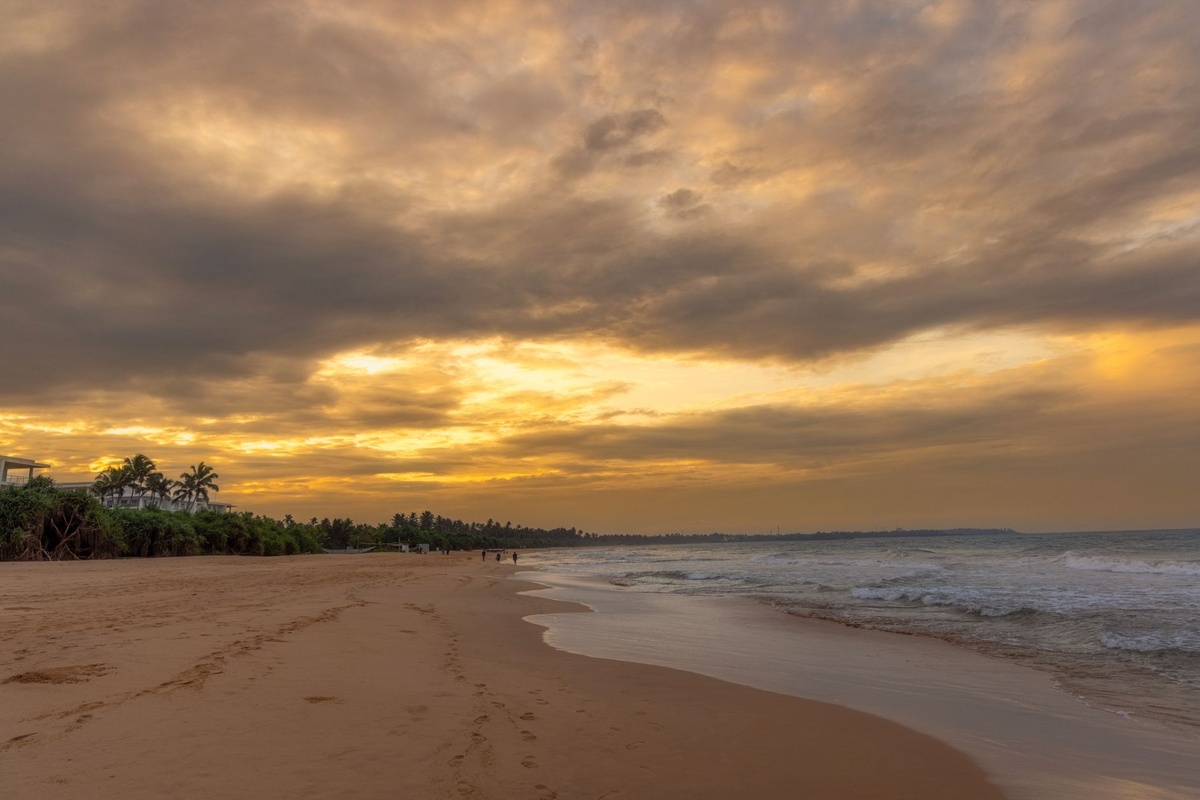
Jungle Beach, a 20-minute walk over the headland, is where you go when the main bay fills up. Rent a snorkel for €3 from any dive shop and swim the reef in the morning before the boats arrive. Skip the “Jungle Beach by boat” tours for €15 — you can walk it.
The trade-off is atmosphere. Unawatuna skews to couples and families, and the beach strip has a touch of package-holiday to it. If you want to talk to strangers at dinner, Mirissa is better. If you want to feel safe on your first night in Asia and walk to Galle Fort for a flat white, Unawatuna is better.
Tangalle: driest, quietest, best luxury
Tangalle is 45 km east of Mirissa and the beach changes character completely — long, wide, golden, with proper surf and often nobody on it. The town is a working fishing port, not a resort. The accommodation is spread along 15 km of coast rather than concentrated in one strip.
This is where Sri Lanka’s best beach hotels are. Amanwella (from around €700/night in December, €900+ over New Year) is the famous one. Anantara Peace Haven Tangalle (€280–350 in early December, €450+ at New Year) is the sensible luxury pick with a fantastic pool and a 2-minute walk to the beach. Buckingham Place near Rekawa (€120–160) is the boutique sweet spot.
For budget travellers the options are thinner: a handful of guesthouses around Medaketiya Beach at €20–30, no proper hostel scene. You’ll eat dinner alone more nights than not. That’s either the point or the problem, depending on your personality.
Two things justify the quiet. Rekawa turtle beach (12 km east) runs nightly volunteer-led turtle watches from about 8 pm; entry is €7 and sightings are most reliable from December onward. And Tangalle is the natural jumping-off point for Yala National Park: a 6 am half-day safari from Tangalle costs €60–80 per jeep (split between up to six people — ask your guesthouse to pool solo travellers), versus €90–120 if you book it from Mirissa.
The verdict: choose Mirissa if…, choose Unawatuna if…, choose Tangalle if…
Use this as your decision framework. Be honest about which description is actually you, not the traveller you’d like to be.
- Choose Mirissa if it’s your first solo trip and you want to meet people without trying, you’re keen to try surfing, and you’d rather spend €10 on a dorm and €60 on whales than €60 on a room.
- Choose Unawatuna if you’re nervous about solo travel, you want the calmest swimming, you’d like Galle Fort’s cafés and bookshops within a €4 tuk-tuk ride, and you don’t mind sharing the beach with families.
- Choose Tangalle if you want the statistically driest weather, you’re spending real money on a hotel, you plan to do Yala, and you’re genuinely happy with your own company for a week.
- Choose Arugam Bay only if you can shift your dates to April–October. For December–January, no.
- Choose a split if you have 10+ nights: 4 nights Mirissa (whales, surf, people), 3 nights Unawatuna (Galle, snorkelling), 3 nights Tangalle (Yala, turtles, beach to yourself). Travel between them is €8–15 by tuk-tuk.
Getting there and around: transfer costs compared
Bandaranaike International Airport (CMB) is north of Colombo, which means every south-coast transfer starts with 35 km of city traffic before you reach the Southern Expressway at Kottawa. The expressway itself is fast and empty: Kottawa to Godagama (Matara) is 126 km in about 80 minutes.
Airport (CMB) to the south coast — December 2026 prices
| Option | To Unawatuna | To Mirissa | To Tangalle | Notes |
|---|---|---|---|---|
| Pre-booked taxi (PickMe app / hotel) | €50–58, 2–2.5 h | €55–65, 2.5–3 h | €65–75, 3–3.5 h | Best for night arrivals; PickMe shows the fare before you confirm |
| Airport taxi counter | €65–75 | €70–85 | €85–100 | Convenient, 20–30% dearer |
| Expressway bus (via Makumbura hub) | €3, 3.5 h | €3.50, 4 h | €4, 4.5 h | Airport bus 187 to Colombo, then Expressway bus; 2 changes with luggage |
| Train (Colombo Fort → Galle/Weligama) | €1.50 (2nd class), 3 h + tuk-tuk | €1.50, 3.5 h + tuk-tuk | €1.50 to Matara + €8 tuk-tuk, 4.5 h | Coastal line is beautiful; book 2nd class reserved at the station |
| Shared shuttle (Facebook groups / hostel) | €15–20 | €18–22 | €22–28 | Hostels pool arrivals; ask before you land |
My opinion: if you land after 7 pm, pay for the pre-booked taxi. The bus-and-train combination is a fun thing to do on day three when you’re going to Galle for lunch, not on arrival with 30 kg of luggage after a 14-hour flight.
Between the three towns
Local buses on the A2 run every 10–15 minutes from dawn until about 8 pm and cost €0.30–0.60 for any hop between Unawatuna, Mirissa and Tangalle. They’re hot, loud and stop everywhere; Mirissa to Unawatuna takes about 50 minutes by bus versus 35 minutes by tuk-tuk (€8).
Use PickMe (the local ride-hailing app, works for tuk-tuks and cars) rather than haggling on the roadside. A metered PickMe tuk-tuk from Mirissa to Tangalle is around €12–14 for 45 km; the same ride quoted by a tuk-tuk driver waiting outside your hostel will start at €25.
Renting a scooter costs €7–9 per day. You technically need an International Driving Permit validated at the AA office in Colombo; most rental shops won’t ask, but your travel insurance will if you crash. For a first solo trip, I’d stick to tuk-tuks.
A costed 10-night sample plan (early January 2027)
This assumes you arrive 8 January and leave 18 January — after the New Year surge, in peak-dry weather, with prices back down to roughly early-December levels. Figures are for one solo traveller, mid-range (private guesthouse rooms, one splurge night), converted to EUR.
| Item | Detail | Cost (EUR) |
|---|---|---|
| Flights | Return from Western Europe, one-stop (Qatar/Emirates/Turkish), booked by end of November | €650–850 |
| Visa (ETA) | 30-day tourist ETA via eta.gov.lk, most nationalities | €47 (US$50) |
| Airport → Mirissa | Pre-booked PickMe car | €60 |
| Nights 1–4: Mirissa | Private AC room with breakfast, Udupila Road area, €30 × 4 | €120 |
| Whale watching | Raja & the Whales, incl. breakfast | €60 |
| Surf lesson | 2-hour group lesson, Weligama (15 min away) | €15 |
| Nights 5–7: Unawatuna/Thalpe | Garden room, Thalpe end, €38 × 3 | €114 |
| Galle Fort day | Tuk-tuk return €8, lunch and coffee €15, Fort museum €4 | €27 |
| Nights 8–9: Tangalle | Buckingham Place or similar boutique, €140 × 2 | €280 |
| Yala half-day safari | Jeep share (3 people) + park fees | €55 |
| Rekawa turtle watch | Entry + tuk-tuk | €15 |
| Night 10: near airport | Negombo guesthouse for an early flight | €30 |
| Food & drink | €14/day average: local breakfasts, one €8–10 dinner, a beer or two | €140 |
| Local transport | Tuk-tuks and buses between towns, Tangalle → Negombo taxi €80 | €130 |
| eSIM / data | Airalo 10 GB / 30 days, or Dialog tourist SIM at the airport (~€6 for 50 GB) | €6–15 |
| Total on the ground | 10 nights, mid-range with one boutique splurge | ≈ €1,100 |
| Total including flights | ≈ €1,800–2,000 |
Pure budget version — dorms throughout, no Yala, no boutique night, buses only — comes in around €450 on the ground for the same 10 nights. Pure luxury — Cape Weligama and Anantara, private driver throughout — is €3,500+ before flights.
One seasonal note worth acting on this week: November is the cheapest month globally for luxury hotels, and Sri Lanka follows the pattern. If you’re eyeing Anantara or Amanwella, look at Black Friday rates for 1–18 December stays; I’ve seen 25–35% off compared with the same rooms in mid-January, and the weather difference is marginal by the second week of December.
Tech and practical kit for a solo traveller on the south coast
Connectivity is good along the whole A2 corridor — Dialog has 4G everywhere from Galle to Tangalle, and most guesthouses have usable Wi-Fi. For a two-week trip, either grab a Dialog tourist SIM at the airport arrivals hall (open 24 hours, around €6 for 50 GB, bring your passport) or install an Airalo Sri Lanka eSIM before you fly so you can call a PickMe car the moment you land.
Power is 230 V with Type D and Type G sockets — the old British three-pin — so a UK plug works and European plugs need an adapter. Power cuts are rare now but short brownouts happen during afternoon storms in December. A compact GaN charger that can refill a phone in 30 minutes between outages earns its place in the bag; I’ve been travelling with the ESR 45W Xtend charger this year and it’s handled Sri Lanka’s slightly wobbly voltage without complaint.
Other practical bits:
- Apply for the ETA at eta.gov.lk at least a week before flying. It’s US$50 for most nationalities and usually approved within 24 hours. Use the official site only — the first Google results are often third-party resellers charging US$80+ for the same thing.
- Carry cash. Guesthouses, roti shops and tuk-tuks are cash-only. ATMs from Commercial Bank and HNB charge about €1.20 per withdrawal; max withdrawal is usually 100,000 LKR (≈€295). Avoid airport exchange counters — the Mirissa and Galle rates are 3–4% better.
- Download PickMe before you land and link a card. It’s the single biggest money-saver on this coast.
- Watch the sea flags. Even in dry season, Mirissa’s west end and Tangalle’s Medaketiya have rip currents. Unawatuna’s bay is the only one of the three I’d call safe for weak swimmers.
- If your inbound flight is delayed 3+ hours on an EU-departing or EU-carrier flight, you’re likely owed €600 under EU261; AirHelp handles the claim for a cut and saves you arguing with Qatar Airways’ chatbot.
- Dress code matters at temples — shoulders and knees covered. Pack one sarong; it doubles as a beach towel.
Common mistakes on a first Sri Lanka winter trip
I see the same handful every year in hostel kitchens and Facebook groups. Avoid them and you’ll have a better fortnight than 80% of first-timers.
- Booking Arugam Bay because of a photo. That photo was taken in July. In December the surf shops are padlocked and it rains 16 days a month.
- Flying in on 22 December with nothing booked. The south coast runs at near-100% occupancy from 22 December to 4 January. Walk-in rates are double, and the decent places are full. Book by late November or shift your dates to 8 January onward.
- Ignoring compulsory gala dinners. Many 4- and 5-star hotels add a mandatory Christmas Eve and New Year’s Eve dinner supplement of €50–150 per person. It’s in the fine print on Booking.com; read it before you pay.
- Trying to “do” the whole island in 10 days. Ella, Sigiriya and Kandy are 5–7 hours from the coast. A first solo winter trip is better spent properly on the south coast than spent on buses.
- Taking the cheapest whale boat. €35 vs €60 sounds like a saving until you’re on a 60-person boat that ignores the approach-distance rules and the whales dive before you get near.
- Underestimating early-December afternoons. Plan beach mornings and indoor or covered afternoons (Galle Fort, a cooking class, a massage at €15–20 for an hour) in the first ten days of the month. By mid-January you can stop planning around it.
- Haggling for tuk-tuks on the street. You’ll pay 50–100% over the PickMe fare and feel annoyed about it for the rest of the day.
Final call
For December–January, the data doesn’t leave much room for debate: the south coast is dry, the sea is calm, and the whales are in. Arugam Bay is a brilliant town that you should visit in a different season. Among the southern three, Mirissa is the best first solo base, Unawatuna is the gentlest introduction, and Tangalle is where you go for the driest skies and the best hotels.
If you can swing it, split your trip and see all three — the whole stretch is a €15 tuk-tuk ride end to end. And if you’re reading this in mid-November 2026 with Black Friday a week away, the best move you can make today is to lock in flights for early December or the second week of January and book the Mirissa room now, before the Christmas crowd does it for you.
Frequently Asked Questions
Is Arugam Bay worth visiting in December or January?
No. Arugam Bay is in the northeast monsoon from late October to January, with roughly 330 mm of rain in December and 170 mm in January, a rough brown sea and no surfable waves. Most surf camps and beach restaurants close from November to March; the season runs April–October.
How much does a solo trip to Sri Lanka’s south coast cost in January 2027?
On the ground, budget about €45/day in hostels and local restaurants, €90–110/day for private guesthouse rooms with a whale-watching trip and a safari, and €250+/day for boutique or luxury hotels. Add €650–850 for return flights from Europe and €47 for the ETA visa.
Which is the driest south-coast town in December?
Tangalle. Its nearest weather station (Hambantota) averages about 120 mm in December and 60 mm in January, versus roughly 150 mm and 85 mm at Galle, which covers Mirissa and Unawatuna. The difference is most noticeable in the first half of December.
Is Mirissa safe for a solo female traveller?
Yes, by South Asian standards it’s one of the easiest places to travel alone: a compact beach town with a strong hostel scene and lots of other solo travellers in January. Standard precautions apply — use PickMe rather than street tuk-tuks at night, avoid swimming alone at the rip-prone west end, and dress modestly away from the beach.
When is the best time to go whale watching in Mirissa?
December to April, with the calmest seas and highest blue-whale sighting rates from mid-January to March. Boats leave around 6:30 am and tours last 4–5 hours; a responsible operator like Raja & the Whales costs about €60 per person including breakfast.

About the Author: Tomáš Bzirský
Founder and editor of Distratech. Based in the Czech Republic, travelling regularly from Central Europe. Writes practical travel guides and travel-tech comparisons (eSIM, apps, airports) in six languages.