Updated September 27, 2026.
You’ve seen the Instagram reels: women walking alone in Tokyo at midnight, spotless trains and lost wallets returned intact. But is Japan actually safe for solo female travelers in 2026—or is that just good PR?
The short answer is yes: Japan remains a low-risk destination for women traveling alone. However, the statistics are more nuanced than Japan’s reputation suggests. Reported crime has risen from pandemic-era lows, train groping and stalking remain concerns, and nightlife scams can catch visitors who assume the country is risk-free.
Here’s what the most recent comparable crime data, local laws and practical safety guidance mean for a solo trip in late 2026.
Key Takeaways
- Japan recorded 737,679 Penal Code offenses in 2024, or approximately 596 per 100,000 residents. That was an increase from pandemic-era levels, but serious violence and stranger homicide remain uncommon.
- Groping on crowded trains, known as chikan, remains one of the most relevant risks for women. Women-only cars operate on selected lines and schedules, usually during weekday rush hour.
- Call 110 for police and 119 for fire or ambulance services. Urban police boxes, or koban, are widespread, although not every location is staffed continuously.
- Capsule hotels and business hotels generally cost about ¥6,000–¥30,000 per night in Tokyo, depending on the date and neighborhood. Autumn weekends and holidays can cost substantially more.
- Japan strictly regulates cannabis, stimulants and other controlled substances. Adderall cannot generally be brought into Japan, even with a foreign prescription, while some other medications require advance approval.
- As of late September, typhoons, lingering heat and transport disruption may pose a greater day-to-day risk than street crime. Check official weather and rail alerts before longer journeys.
1. What the 2026 Crime Statistics Actually Show
Japan remains a comparatively safe country, but the often-repeated figure of 400–450 crimes per 100,000 people is now outdated. National Police Agency data show that recorded Penal Code offenses increased for three consecutive years through 2024.
| Year | Recorded Penal Code Offenses | Approximate Rate per 100,000 |
|---|---|---|
| 2022 | 601,331 | About 480 |
| 2023 | 703,351 | About 565 |
| 2024 | 737,679 | About 596 |
The increase does not mean Japan has suddenly become dangerous. Pandemic restrictions produced unusually low crime totals, while reopened shopping, nightlife and tourism created more opportunities for theft, fraud and public-order offenses. Changes in reporting and sexual-offense laws can also affect year-to-year totals.
International comparisons require caution because countries define, count and record offenses differently. A broad Japanese Penal Code total should not be placed directly beside an American or British crime total as if the categories were identical. More comparable indicators, such as intentional homicide, still place Japan among the world’s lowest-risk countries.
For travelers, the most likely problems are not random violent attacks. More realistic concerns include:
- Groping or covert photography on crowded public transport
- Stalking or persistent unwanted attention
- Pickpocketing in congested nightlife and tourist areas
- Overcharging and drink-related scams at unverified bars
- Online booking, ticket and accommodation scams
- Lost phones, passports and wallets
Sexual harassment is also underreported, so low police totals should never be interpreted as proof that incidents do not occur.
2. The Real Issue: Harassment and “Chikan” on Public Transport
If there’s one safety topic solo female travelers should understand, it’s chikan—unwanted touching or groping, usually on packed commuter trains. Covert photography, sometimes called tōsatsu, is another concern on trains, escalators and station stairways.
Risk is highest when carriages are extremely crowded, particularly during weekday commuting periods of roughly 7–9:30am and 5–7:30pm in Tokyo and Osaka. Conditions vary by line, station and day.
Many major railways designate women-only cars during specific operating periods. Look for platform markings and signs showing the applicable direction, train type and hours. Do not assume that the first or last carriage is always women-only: placement and rules differ between operators.
Women-only cars:
- Usually operate on weekdays and during designated commuting hours
- Are included in the normal fare
- May operate in only one direction or on selected services
- May also be used by young children, passengers with disabilities and their caregivers under operator rules
- Do not operate on every Tokyo, Osaka or Kyoto line
A typical central Tokyo rail or subway journey costs approximately ¥180–¥350. A metered taxi starts at roughly ¥500 in central Tokyo, with time, distance, tolls and a late-night surcharge—normally 20% between 10pm and 5am—added to the fare.
If someone touches or photographs you without consent:
- Move away and say “Chikan!” or “Yamete kudasai” (“Please stop”) loudly if you feel able to do so.
- Ask another passenger for help and move toward the conductor’s compartment or platform staff.
- Tell station staff immediately. The phrase “Chikan ni aimashita” means “I was groped.”
- Record the train line, carriage number, time, station and a description of the person.
- Call 110 if you are in immediate danger or want police assistance.
Your safety comes first. You are not required to confront or physically detain anyone. If a carriage feels wrong, step off at the next station and wait for a less crowded train.
Taxis are regulated and generally safe. Use an official taxi rank or a recognized app such as GO, S.RIDE or Uber, verify the license plate and sit in the rear. A taxi between Haneda Airport and Shinjuku commonly costs about ¥9,000–¥14,000 after tolls and possible surcharges, while rail typically costs under ¥1,000 but may require a transfer.
3. Street Safety at Night: Can You Walk Alone?
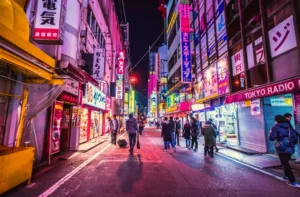
In most Japanese neighborhoods, yes. Central areas of Tokyo, Osaka and Kyoto remain busy, illuminated and well served by late-opening businesses. Convenience stores such as 7-Eleven, Lawson and FamilyMart provide a staffed place to stop, charge a phone, ask for assistance or wait for a taxi.
That does not make every nightlife district trouble-free:
- Shinjuku and Kabukicho: The principal risk is being approached by bar touts, hosts or street promoters. Do not follow anyone into an unverified venue, even if entry or drinks are advertised as free.
- Roppongi: Use established venues and keep control of your drink. Unexpected bills and drink-related theft are more plausible here than random street violence.
- Shibuya: Busy and heavily monitored, but crowded crossings, clubs and late-night drinking require normal big-city awareness.
- Osaka’s Dotonbori and parts of Namba: Generally safe, but watch for aggressive promoters and inflated bar charges.
- Asakusa: Quieter after the tourist sites close. It suits travelers seeking calmer evenings, although some streets become nearly empty late at night.
Never hand a tout your phone, card or passport, and do not allow a venue to run an open-ended tab. Check recent reviews, confirm prices before ordering and pay after seeing an itemized bill. If a situation becomes confrontational, leave and contact police rather than arguing inside the venue.
If you’re deciding where to stay, I break down hotel pricing and vibe differences in this detailed Tokyo neighborhood comparison guide. For autumn 2026, well-reviewed rooms under ¥25,000 are still available, but rates rise sharply on Saturdays, public-holiday weekends and during peak foliage dates.
Typical late-2026 accommodation ranges are:
| Hotel Type | Typical Nightly Price | What to Check |
|---|---|---|
| Capsule hotel with women-only area | ¥6,000–¥12,000 | Separate access, secure luggage storage and staffed reception |
| Business hotel | ¥12,000–¥30,000 | 24-hour desk, elevator key control and recent guest reviews |
| Midrange or upscale hotel | ¥25,000–¥60,000+ | On-site staff, luggage service and controlled entry |
| Luxury hotel | ¥60,000–¥150,000+ | Concierge service and comprehensive building security |
Prices fluctuate with demand and exchange rates, so yen is a more useful planning currency than a fixed U.S. dollar conversion. In Kyoto, rooms can sell out or double in price during the late-October-to-November foliage period.
A hostel can be perfectly suitable if it has strong recent reviews, lockers large enough for valuables, privacy curtains and a women-only dorm option. Avoid properties with repeated complaints about broken locks, absent staff or unrestricted public access.
4. Local Laws That Solo Female Travelers Must Know
Japan feels relaxed socially, but its laws on drugs, medication, identification and public conduct are strict. “It is legal in my home country” is not a defense.
Drugs and CBD: Strict Rules
Japan criminalized unauthorized cannabis use in addition to possession under reforms that took effect in December 2024. Bringing cannabis, THC edibles, vape cartridges or cannabis-derived medication into the country can lead to arrest, detention and deportation.
CBD is not automatically safe to import. Products must comply with Japan’s strict residual-THC limits, and an item sold legally overseas may not qualify. The lowest-risk option is not to travel with cannabis-derived products unless you have confirmed compliance through the appropriate Japanese authority.
Prescription Medication
Check the active ingredient, not just the brand name. Amphetamine products such as Adderall are generally prohibited and cannot be made legal simply by carrying a prescription or obtaining a standard import certificate.
Other controlled medicines—including some stimulants, narcotic painkillers, sedatives and products containing ingredients such as lisdexamfetamine—may require advance authorization. Depending on the drug and quantity, this may involve an Import Confirmation, formerly called a Yunyu Kakunin-sho, or separate narcotics-control approval.
Before departure:
- Check the Ministry of Health, Labour and Welfare guidance for your exact active ingredient.
- Apply early if advance permission is required.
- Carry medication in its original labeled packaging.
- Bring a copy of the prescription and a doctor’s letter.
- Do not mail medication to Japan without confirming that it is legal.
Age of Consent, Harassment and Covert Photography
Japan raised the national age of consent to 16 in 2023 and strengthened laws concerning sexual offenses and non-consensual photography. Local ordinances and child-protection rules can impose additional restrictions.
Victims of sexual violence or harassment can contact police on 110. Japan also operates the nationwide sexual-crime consultation number #8103 and the one-stop support line #8891, although English availability can vary.
Self-Defense Items
Personal safety alarms are legal, inexpensive and widely available. Carrying knives or other potential weapons can result in questioning or arrest, and blade-length rules are not a safe loophole for tourists.
Pepper spray is legally complicated. Possession is not the same as having a lawful reason to carry or use it, and inappropriate use can create criminal liability. A loud alarm, phone access and early movement toward a staffed location are safer recommendations.
Carry Your Passport
Foreign visitors are legally required to carry their passport while in Japan and show it when requested by an authorized officer. A photo or photocopy is useful as a backup but does not replace the original for this requirement.
Bicycles and E-Scooters
Do not use a phone while cycling, ride after drinking or assume pedestrian rules apply to rental e-scooters. Japan increased penalties for distracted and impaired cycling in November 2024. Follow traffic signals, use lights after dark and wear a helmet even where enforcement is limited.
5. Police, Emergency Help & Reporting Crimes
Police boxes, known as koban, are common near stations and busy intersections. They can help with reports, directions and lost property, but not every koban is staffed 24 hours a day. If the nearest one is unattended, use the posted phone or call 110.
Save these numbers before your trip:
- 110: Police emergencies
- 119: Ambulance and fire
- #9110: Non-emergency police consultation
- #8103: Police sexual-crime consultation line
- #8891: One-stop support for sexual-violence victims
- 050-3816-2787: Japan Visitor Hotline operated by JNTO for visitor assistance, including emergencies
English-speaking staff are not guaranteed, particularly outside major cities. Emergency operators may use interpretation services, but simple information helps: state the place name, nearest station or landmark, what happened and whether anyone is injured.
Useful phrases include:
- “Tasukete kudasai”: Please help me.
- “Keisatsu o yonde kudasai”: Please call the police.
- “Kyūkyūsha o yonde kudasai”: Please call an ambulance.
- “Eigo o hanaseru hito wa imasu ka?”: Is there someone who speaks English?
If you report an incident, ask for an interpreter before signing a statement you do not understand. Keep copies or photographs of report details, receipts and medical documentation for insurance purposes.
For lost property, contact the station office or railway operator first if the item disappeared on public transport. Japan’s lost-property system is effective, but recovery is not guaranteed, so use a tracker and keep your passport, cards and cash separated.
6. Rural Japan vs Cities: Is There a Difference?
Rural Japan usually has less street crime than major cities, but the practical safety risks are different. Transport runs less frequently, taxis may require reservations, mobile coverage can weaken in mountain areas and some towns have limited late-night staffing.
Do not rely on a remembered last-train time. Seasonal schedules, limited express reservations, weather and construction can change service. Check the operator’s official timetable on the day you travel and aim for the second-to-last connection when possible.
Outdoor risks also deserve more attention in autumn 2026:
- Bears: Check local alerts before hiking in Hokkaido, Tohoku, Nagano and other mountain regions. Avoid headphones, carry a bear bell where recommended and do not approach wildlife.
- Shorter daylight: Mountain trails become dark earlier than city streets. Start hikes early and carry a headlamp.
- Typhoons and heavy rain: September and October storms can suspend trains, close roads and trigger landslide warnings.
- Earthquakes: Enable emergency alerts and know your accommodation’s evacuation route.
- Onsen rules: Most baths are separated by gender, but some rural or mixed-bathing facilities have different customs. Confirm the arrangement before booking if privacy matters to you.
Autumn foliage season now replaces summer festivals as the main booking pressure. Kyoto, Nikko, Hakone and mountain destinations can become crowded from October through November, so reserve accommodation and limited express trains early.
7. Tech Tips That Increase Safety
Reliable mobile data is one of the most useful safety tools in Japan. It lets you receive weather alerts, check the last train, translate an address and call a verified taxi without relying on public Wi-Fi.
Current eSIM pricing varies by provider and data allowance. As a broad late-2026 guide, smaller packages may cost around $10–$20, while larger or unlimited-style plans commonly cost $20–$50 for a multiweek trip. Confirm whether “unlimited” plans reduce speeds after heavy use.
Carrier roaming can be convenient but often costs around $10–$12 per day or requires a monthly international pass. Before buying either option, compare data limits, hotspot support, network coverage and whether your phone is unlocked.
I did a full breakdown of roaming vs eSIM costs here: Is Roaming Ever Cheaper Than an eSIM?
Use your connection to:
- Share your live location with a trusted contact
- Save your hotel address in Japanese and English
- Check official train status rather than relying only on route-planning apps
- Book taxis through GO, S.RIDE or Uber
- Download offline maps and Japanese translation files
- Store encrypted copies of your passport, insurance and prescriptions
Download Japan’s official Safety tips app, which provides earthquake, tsunami, volcanic, heat and severe-weather alerts in multiple languages. The NHK World-Japan app is also useful for English-language emergency reporting.
Late September can still be hot and humid, particularly in Tokyo, Osaka and southern Japan. Carry water, take heat warnings seriously and avoid long walks with luggage during the warmest part of the afternoon. At the same time, monitor typhoon forecasts and avoid traveling into areas under evacuation or landslide warnings.
So… Is Japan Safe for Solo Female Travelers in 2026?
Yes. Statistically and practically, Japan remains one of the lower-risk destinations for women traveling alone. Serious violence against visitors is uncommon, public transport is extensive and help is usually nearby in urban areas.
However, “safe” should not be confused with “risk-free.” Train groping, covert photography, stalking, nightlife scams and medication mistakes are all more relevant than Japan’s polished image may suggest.
The best precautions are straightforward:
- Avoid following nightlife touts into unfamiliar venues.
- Use women-only train cars when available, but still remain aware of your surroundings.
- Choose accommodation with controlled access and recent reviews.
- Confirm every prescription medication before departure.
- Carry your passport and keep digital backups of essential documents.
- Stay connected and monitor transport and weather alerts.
- Tell someone your route before hiking or visiting a remote area alone.
Japan is still an excellent choice for a first solo trip. For an autumn 2026 itinerary, combine Tokyo and Kyoto with a smaller city or onsen town—but reserve early for foliage season and leave flexibility for typhoon-related changes.
Frequently Asked Questions
Is Japan safe for solo female travelers at night?
Yes, most urban neighborhoods are low-risk for women walking alone. Exercise more caution in nightlife districts such as Kabukicho, Roppongi and parts of Namba, where touts, overcharging and drink-related scams are more realistic concerns than random violence.
Are women-only train cars free in Japan?
Yes. They are included in the normal fare, but they operate only on selected lines, directions and schedules. Check platform signs because the designated carriage and hours vary by operator.
How much does a safe hotel cost in Tokyo in late 2026?
Women-only capsule accommodation generally starts around ¥6,000–¥12,000 per night. A well-reviewed business hotel with staffed reception commonly costs ¥12,000–¥30,000, with higher prices on weekends and peak autumn dates.
What should I do if I feel unsafe in Japan?
Enter a staffed station, hotel, convenience store or police box and call 110 if you are in immediate danger. For an ambulance or fire emergency, call 119. Save your location in Japanese so you can show it to staff or emergency operators.
Can I bring Adderall or ADHD medication into Japan?
Adderall contains amphetamine and is generally prohibited, even with a foreign prescription. Other ADHD medications may be permitted or may require advance approval. Check the exact active ingredient with Japan’s Ministry of Health, Labour and Welfare before traveling.
What is the biggest seasonal safety concern in autumn 2026?
Typhoons, heavy rain and transport disruption remain possible in September and October. In mountain regions, shorter daylight and bear activity also require planning. Use official weather alerts and check local trail conditions.

About the Author: Tomáš Bzirský
Founder and editor of Distratech. Based in the Czech Republic, travelling regularly from Central Europe. Writes practical travel guides and travel-tech comparisons (eSIM, apps, airports) in six languages.