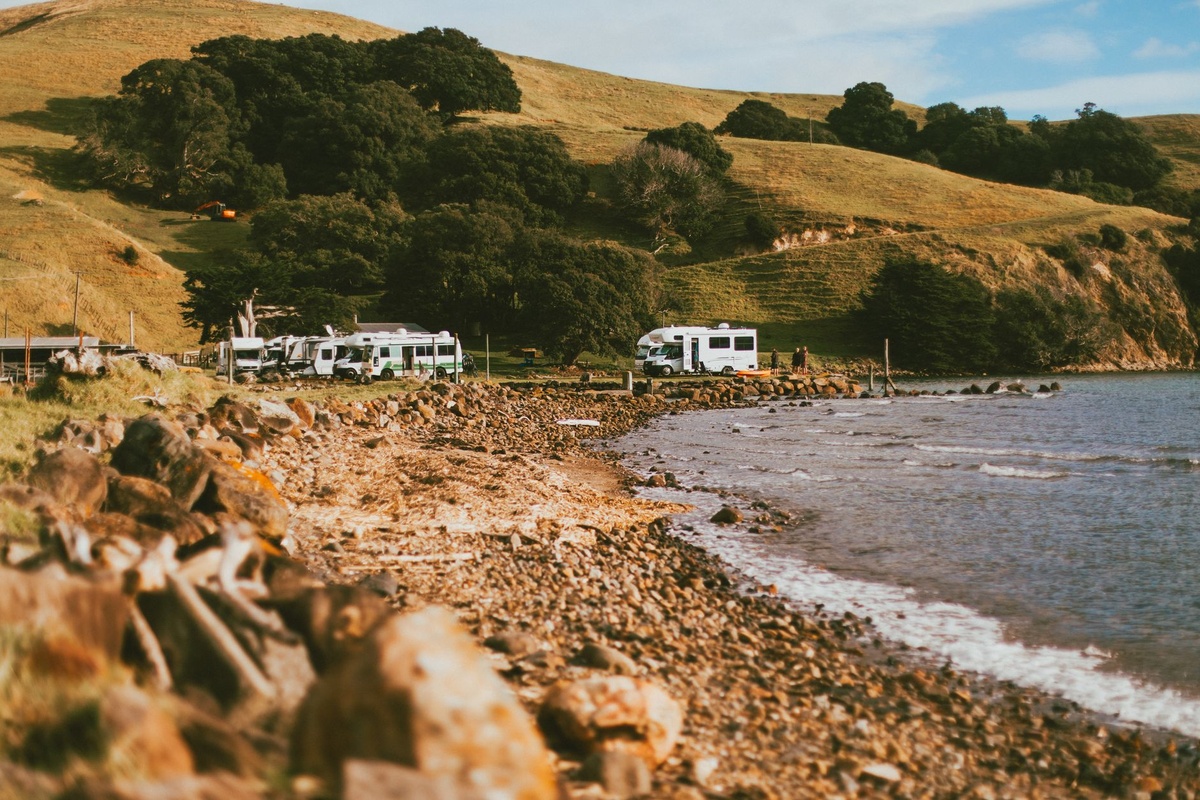
Yes—but only if “weekend” means a genuine 72-hour rental from Friday afternoon to Monday afternoon. This Auckland–Coromandel campervan loop covers roughly 430 kilometers, puts you beside the sea for both nights, and still leaves enough time for Cathedral Cove, Hot Water Beach and one proper Coromandel activity without turning the trip into a relay race.
Key Takeaways
- Allow 72 hours for the 430-kilometer loop; a Friday-evening to Sunday-evening trip is too compressed.
- Budget approximately €610–€760 for two people, including a three-day campervan, campsites, fuel and food at October 2026 planning prices.
- A petrol campervan using 12 L/100 km will burn about NZ$142 (€73/US$82) over 430 kilometers.
- October brings roughly 110–140 mm of rain around Coromandel, so keep Cathedral Cove and beach timings flexible.
- Freedom camping requires a green self-containment warrant and is permitted only where local signs and bylaws allow it.
Key Numbers at a Glance
| Trip metric | Realistic figure | What it means |
|---|---|---|
| Total distance | Approximately 430 km | Expect an odometer range of 420–450 km after food, campsite and beach detours |
| Wheel-turning time | 8.5–10 hours | Navigation apps may show 7 hours, but campervans are slower on SH25 |
| Recommended duration | 72 hours | Friday 14:00 to Monday 14:00 works better than a 50-hour conventional weekend |
| October temperature | Approximately 11–19°C | Warm afternoons are possible; nights still require heating or a good duvet |
| October rainfall | About 110–140 mm around Coromandel | Rain commonly arrives as passing bands rather than three uninterrupted wet days |
| Powered campsites | €31–€49 per van/night | October 2026 planning range, usually NZ$60–95 |
| Estimated fuel | €64–€78 | Depends on petrol versus diesel and whether diesel road-user charges are included |
| Daylight | Roughly 12 hours 40 minutes to 13 hours 30 minutes | New Zealand daylight saving time gives useful evening light |
Currency benchmark used throughout: NZ$1 = €0.51 and US$0.58, rounded for October 2026 trip planning. Rental, fuel and accommodation prices are dynamic; confirm the NZD total before paying.
The Verdict: Who Should Attempt This Loop?
This route works for travelers who can collect near Auckland Airport by 14:00 on Friday and return no earlier than 14:00 Monday. It does not work well if your flight lands Friday evening, because Auckland traffic and an unfamiliar campervan can turn the first 115 kilometers into a four-hour ordeal.
Choose the 430-kilometer loop if…
- You are comfortable driving on the left and handling narrow, winding roads.
- Your campervan contract permits the unsealed 309 Road between Coromandel Town and Whitianga.
- You can change the order of Cathedral Cove and Hot Water Beach around rain and tides.
- You want two distinct bases rather than sleeping in the same holiday park twice.
- You accept that “two hours” on a navigation app may mean 2 hours 40 minutes in a large van.
Choose a shorter Thames–Hahei return instead if…
You have only Friday evening through Sunday, are driving a six-berth motorhome, or your rental company prohibits gravel roads. The shorter alternative skips Coromandel Town and follows SH25A between Thames and the east coast, reducing the trip to roughly 350 kilometers and saving 90–120 minutes.
Choose a car and motel instead if…
A compact rental car is easier on SH25 and may cost €45–€75 per day versus €77–€123 for a two-berth campervan. However, two motel nights around Hahei or Whitianga can cost €110–€180 each, so the combined car-and-room total is not automatically cheaper.
| Option | October 2026 price for two | Driving experience | Best for |
|---|---|---|---|
| Two-berth campervan | €610–€760 total trip | Slowest on SH25; kitchen and bed included | Flexible coastal weekends |
| Car plus two motels | €580–€850 total trip | Easiest and quickest | Nervous van drivers or wet forecasts |
| Six-berth motorhome | €850–€1,150 total trip | Cumbersome on narrow bends | Families who value indoor space |
| Auckland–Hahei return only | Approximately €540–€680 | About 350 km total | A conventional two-night weekend |
My recommendation: rent the smallest self-contained camper that comfortably sleeps your group. Skip the oversized motorhome; an extra meter of vehicle feels substantial when a logging truck appears around a Coromandel bend.
Before Friday: Campervan, Weather and Booking Strategy
Book the van—not just the cheapest headline rate
October is shoulder season, so a basic two-berth camper commonly starts around NZ$150–240 (€77–€123/US$87–$139) per day. Compare operators such as JUCY, Britz, Maui and Apollo, but price the final screen rather than the homepage banner.
Reduced-excess insurance typically adds NZ$45–65 (€23–€33) per day. A van advertised at €79 daily can therefore finish closer to €112 daily before chairs, additional drivers or cleaning fees.
Ask the rental company in writing whether 309 Road is permitted. Parts are unsealed, and unauthorized gravel-road driving can invalidate insurance even when the road itself is legally open.
Build the route around October weather
October is spring in New Zealand, not the dry-season equivalent of an October Mediterranean break. Auckland averages roughly 90–120 mm of rain during the month, while exposed parts of the Coromandel Peninsula can receive around 110–140 mm over 12–15 wet days.
That sounds worse than it usually feels. Coromandel rain often arrives in fast-moving fronts, so a wet Saturday morning can become a bright afternoon; by comparison, October destinations such as Madeira or Sicily are warmer and generally better for guaranteed outdoor dining, as shown in our October island and Mediterranean comparison.
Use MetService for town forecasts and rain radar, then check NZTA Journey Planner before departure. MetService is more useful than a generic phone weather widget here because peninsula rainfall can differ sharply from Auckland’s forecast.
Download the right travel apps
CamperMate and Rankers Camping NZ show dump stations, campsites and public toilets. CamperMate has the denser map; Rankers is better for detailed traveler comments, but neither overrides a roadside prohibition sign or council bylaw.
Install Gaspy to compare live fuel prices. A 20-cent-per-liter difference saves only NZ$10.30 (€5.30) on 51.6 liters, but filling in Thames is still usually smarter than relying on a small peninsula station late at night.
- Download offline Google Maps for Auckland, Thames and Coromandel.
- Save campground confirmations as screenshots.
- Pin dump stations before leaving mobile coverage.
- Check the Hot Water Beach low-tide window at MetService tides.
- Carry a physical payment card; small kiosks do not always tolerate weak mobile data.
Day 1: Auckland to Thames and Coromandel Town
Friday, 14:00–21:00 | Approximately 160 km | 3 hours 20 minutes driving
Collecting a camper takes longer than collecting a car. Allow 60–90 minutes for the inspection, gas demonstration, self-containment paperwork and photographing existing damage; a 14:00 booking can realistically put you on the road around 15:15.
15:15: Leave the Auckland depot
Most large campervan depots are near Auckland Airport or Māngere rather than downtown. From the airport area to Thames is approximately 105–115 kilometers and takes 1 hour 40 minutes in clear traffic versus 2 hours 20 minutes or more during the Friday exodus.
Use SH1 south, then SH2 and SH25 through the Hauraki Plains. Skip central Auckland sightseeing on pickup day; adding the CBD can cost 60–90 minutes and approximately NZ$8–16 (€4–€8) in parking.
17:15: Thames fuel and grocery stop
Thames is the best practical resupply point. Pak’nSave generally beats small Coromandel convenience stores, and its normal hours are around 08:00–21:00 daily, although public-holiday hours can differ.
Budget NZ$90–120 (€46–€62/US$52–$70) for two breakfasts, picnic lunches, snacks and one campervan dinner. Buying the same basket piecemeal at peninsula stores can cost 15–25% more.
Fill the tank here if necessary. Thames typically has several competing stations, whereas late-evening choice becomes thinner beyond town.
18:00: Thames to Coromandel Town
The 52-kilometer Thames Coast Road is beautiful but slow, with tight curves and limited shoulders. Navigation may estimate 55 minutes; in a campervan, allow 70–80 minutes without photo stops.
Do not chase sunset viewpoints from unsafe pull-offs. Use signed bays, and let faster local traffic pass whenever a proper slow-vehicle area appears.
19:30: Dinner and first campsite
For dinner, book Pepper Tree Restaurant and Bar on Kapanga Road, a better first-night choice than trying to cook after the Friday drive. Mains generally land around NZ$30–45 (€15–€23), with seafood usually costing more than burgers or pasta; confirm current service hours directly because winter and shoulder-season schedules change.
Stay at Coromandel TOP 10 Holiday Park, within walking distance of the town center. Powered sites commonly price around NZ$60–80 (€31–€41) for two adults in October, compared with roughly €23–€31 for basic unpowered sites.
Pay for power if nighttime temperatures are forecast below 10°C. Saving €8 and then discovering your rental’s heater works only on mains power is a poor trade.
Day 2: Coromandel Town, 309 Road and Hahei
Saturday, 08:00–20:30 | Approximately 90 km | 2 hours 15 minutes driving
Saturday carries the most sightseeing but the least mileage. Your two non-negotiable timing constraints are any prebooked morning activity and the Hot Water Beach tide window.
08:45: Driving Creek Railway
Driving Creek Railway is not a throwaway tourist train: the narrow-gauge line climbs through regenerating native forest to the Eyefull Tower viewpoint. Railway tours usually take about 1 hour 15 minutes, with departures commonly scheduled between approximately 09:00 and 16:00.
Plan on roughly NZ$49–55 (€25–€28/US$28–$32) per adult at October 2026 rates. The train is better value for a 72-hour itinerary than the longer zipline experience, which can consume close to three hours and cost around NZ$140–160 (€72–€82).
Skip the zipline on this loop; take the first railway departure instead. You preserve enough daylight for Waterworks, the 309 Road and Hahei without driving after dark.
10:45: Choose your route to Whitianga
| Coromandel Town to Whitianga | Distance | Driving time | Road surface | Verdict |
|---|---|---|---|---|
| 309 Road | Approximately 40–45 km | 60–80 min without stops | Partly unsealed, narrow | Use only with written rental permission |
| SH25 via Kuaotunu | Approximately 75–82 km | 1 hr 20–1 hr 40 | Sealed | Safer contractual choice |
The advertised 430-kilometer loop assumes the 309 Road. Taking sealed SH25 instead adds around 35 kilometers, bringing the weekend total closer to 465 kilometers.
On the 309, stop at Waiau Falls for 15–20 minutes. The short approach is free, whereas nearby The Waterworks is a paid, family-oriented attraction that deserves at least 90 minutes.
The Waterworks generally operates from around 10:00 to 16:00 or 17:00 depending on season, with adult entry approximately NZ$28–32 (€14–€16). Choose it on a wet day; skip it in clear weather and protect time for the coast.
13:00: Whitianga lunch
Whitianga is the practical lunch stop. Blue Ginger is my pick when open, with Asian-inspired plates commonly around NZ$20–35 (€10–€18); check its current lunch days because shoulder-season service can be limited.
If Blue Ginger is closed, buy takeaway and eat by the waterfront rather than spending 90 minutes on a formal meal. A café lunch for two costs roughly NZ$45–65 (€23–€33), compared with NZ$20–30 (€10–€15) for bakery pies, fruit and coffee.
14:30: Whitianga to Hahei
The drive to Hahei is approximately 35 kilometers and usually takes 35–45 minutes. This section is sealed, but expect bends, one-lane bridge etiquette and weekend traffic around beach turnoffs.
Check in at Hahei Beach Resort, where powered sites commonly run around NZ$70–95 (€36–€49) for two in October. It costs more than inland parks, but walking access to the beach saves driving and parking stress.
16:00: Hot Water Beach—or a weather backup
Hot Water Beach’s geothermal pools are accessible roughly two hours either side of low tide. Outside that window, it is simply an attractive surf beach; tide timing matters more than the clock time printed in any fixed itinerary.
Spade hire is typically NZ$10–15 (€5–€8), but the best pockets can be crowded. Skip digging if low tide falls after dark or coincides with rough surf; October water temperatures are cool, and beach conditions can change quickly.
If the tide is wrong, walk Hahei Beach and visit Hot Water Beach early Sunday instead. For a rainy backup, Whitianga’s The Lost Spring offers geothermal pools, but entry can cost approximately NZ$75–105 (€38–€54) per adult—more than two nights of campsite upgrades.
19:00: Dinner at The Pour House
The Pour House in Hahei is the easy second-night answer, serving craft beer, pizza and casual plates. Allow NZ$55–85 (€28–€44) for dinner for two before multiple drinks, and reserve ahead on school-holiday or long-weekend Saturdays.
Cooking at the campsite cuts dinner to about NZ$25–35 (€13–€18). The restaurant is worth it if the weather is poor; on a bright evening, a campsite dinner near the beach is the better Coromandel experience.
Day 3: Cathedral Cove and the Return to Auckland
Sunday/Monday final day, 07:30–14:00 | Approximately 180 km | 3 hours driving
For a true 72-hour rental, this is Monday morning. If you must return Sunday, begin this schedule a day earlier and accept that your trip is closer to 50 hours.
07:30: Walk to Cathedral Cove
The repaired land route to Cathedral Cove reopened after earlier storm closures, but conditions and access can still change after heavy rain. Check the Department of Conservation Cathedral Cove page immediately before setting out.
Allow approximately 90 minutes to two hours return, depending on the active trailhead and your pace. The route includes hills and steps, so it is a walk rather than a flip-flop stroll.
Arriving before 08:00 is substantially better than arriving at 10:30. You gain softer light and fewer day-trippers, while leaving a safety buffer for the Auckland return.
If the track is closed, the Cathedral Cove Water Taxi from Hahei is the faster alternative when sea conditions permit. Expect roughly NZ$80–95 (€41–€49) per adult return, versus a free walk plus any local parking or shuttle fee.
09:45: Depart Hahei
Leave no later than 10:00 for a 14:00–15:00 depot return. Hahei to an Auckland Airport-area depot is roughly 170–180 kilometers and takes about 2 hours 40 minutes in ideal conditions, but roadworks or Auckland traffic can push that beyond three hours.
Follow SH25 toward Tairua, cross the restored SH25A connection toward Thames, then continue via SH2 and SH1. Compared with backtracking through Coromandel Town, SH25A saves approximately 70–90 kilometers and at least an hour.
11:15: Fuel and driver change
Stop around Thames or the Hauraki Plains for fuel, coffee and a driver swap. A 15-minute stop is cheaper than a late-return charge, which can exceed NZ$100 (€51) before the operator adds staff or transfer costs.
Refill near the depot only if the rental contract requires a full tank and prices are reasonable. Photograph the pump receipt, dashboard fuel gauge and final odometer before handing over the keys.
What the 430 Kilometers Actually Cost
A compact petrol camper typically consumes 11–13 liters per 100 kilometers. At 12 L/100 km, this route uses approximately 51.6 liters.
With petrol at NZ$2.75 per liter, fuel costs NZ$142 (€73/US$82). A fuel-efficient car using 7 L/100 km would consume only 30.1 liters, costing about NZ$83 (€42/US$48)—a €31 saving.
Diesel appears cheaper at the pump, but New Zealand applies road-user charges. For 430 kilometers, a diesel camper might use about NZ$93 (€47) of fuel plus roughly NZ$33 (€17) in road-user charges, producing a realistic total near €64 before rental-company administration fees.
| Vehicle | Consumption assumption | Fuel/RUC for 430 km | October 2026 estimate |
|---|---|---|---|
| Petrol two-berth camper | 12 L/100 km | 51.6 L × NZ$2.75 | NZ$142 / €73 / US$82 |
| Diesel camper | 10.5 L/100 km plus RUC | NZ$93 fuel + approximately NZ$33 RUC | NZ$126 / €64 / US$73 |
| Compact petrol car | 7 L/100 km | 30.1 L × NZ$2.75 | NZ$83 / €42 / US$48 |
Do not choose diesel solely to save €9 in operating costs. The van’s daily rate, insurance excess and road-user-charge policy matter far more than the pump price.
Costed 72-Hour Budget for Two People
This sample assumes a shoulder-season two-berth camper, reduced-excess insurance, two powered holiday-park nights, one restaurant dinner and mostly supermarket food. It excludes flights and international travel insurance.
| Expense | NZD | EUR, October 2026 | USD, October 2026 |
|---|---|---|---|
| Campervan, 3 days at NZ$180 | NZ$540 | €276 | US$313 |
| Reduced-excess insurance | NZ$150 | €77 | US$87 |
| Two powered holiday-park sites | NZ$155 | €79 | US$90 |
| Petrol for 430 km | NZ$142 | €73 | US$82 |
| Groceries | NZ$115 | €59 | US$67 |
| One dinner and one café lunch | NZ$125 | €64 | US$73 |
| Driving Creek Railway for two | NZ$104 | €53 | US$60 |
| Spade hire, parking and incidentals | NZ$35 | €18 | US$20 |
| Total | NZ$1,366 | €699 | US$792 |
A stripped-back version using unpowered sites, campsite cooking and no paid railway can land near €540–€590. A premium camper, full insurance package, water taxi and restaurant meals can push the same weekend beyond €900.
Freedom Camping Rules You Cannot Ignore
Freedom camping does not mean parking anywhere that lacks a gate. National law, Department of Conservation rules and district bylaws overlap, and the Thames-Coromandel District Council can prohibit camping in popular coastal areas even when your vehicle is certified.
Since June 2025, vehicles relying on self-contained status for council-controlled freedom camping must meet the newer certification requirements and display a green warrant. That generally requires a permanently fixed toilet; an old blue sticker or portable toilet is not sufficient for this purpose.
Check the vehicle’s green warrant expiry date before leaving the depot. A rental employee saying “it’s self-contained” is less useful than the actual certification label and documentation.
Use this three-part legality test
- Is the van currently green-warrant certified? If not, assume self-contained-only sites are unavailable.
- Does the council or DOC map permit camping at that exact location? Rules can vary between adjacent car parks.
- Does the sign impose a time, space or night limit? Arriving after designated bays are full does not create an extra legal space.
Consult the Thames-Coromandel District Council freedom-camping page and current bylaw maps. Fines can be hundreds of New Zealand dollars, making a €35 holiday-park site the cheaper decision.
For this compressed itinerary, I recommend paid parks both nights. Compared with hunting for a legal bay after dark, advance-booked sites save 30–60 minutes, provide hot showers and remove uncertainty about toilets, wastewater and overnight signs.
Common Mistakes That Ruin This Weekend
Calling 48 hours a 72-hour trip
Friday 18:00 to Sunday 18:00 is only 48 hours. It forces either a late first drive or an early Cathedral Cove exit, whereas an actual Monday return creates a usable final morning.
Trusting navigation-app driving times
A map may calculate around seven hours for the loop, but realistic wheel-turning time is 8.5–10 hours. Add campervan acceleration, one-lane bridges, fuel stops and opportunities to let traffic pass.
Taking 309 Road without permission
The 309 saves roughly 35 kilometers compared with sealed SH25, but an insurance exclusion could expose you to thousands in damage costs. If permission is unclear, take the sealed road and accept a 465-kilometer weekend.
Ignoring Hot Water Beach tides
The geothermal experience works around low tide, not when your itinerary says “beach time.” Check the tide first, then swap Saturday afternoon with Sunday morning if required.
Returning the camper straight from Cathedral Cove
Sand, dishes and wastewater take time to address. Allow 30–45 minutes before departure to sweep the van, secure cupboards, empty approved wastewater facilities and photograph the interior.
Driving the coast after dark
October daylight saving helps, but unlit bends remain tiring after rain. A daylight 70-minute coastal drive is safer and more enjoyable than the same road at night with glare on a wet windscreen.
Final Verdict: Is the Auckland–Coromandel Loop Worth It?
A 430-kilometer Auckland–Coromandel campervan loop is entirely achievable in 72 hours, and October is a smart shoulder-season month if you tolerate changeable weather. You get longer daylight, lower camper rates than midsummer and waterfalls running strongly after spring rain.
The trip stops being enjoyable when squeezed below about 60 hours. For a normal Friday-night-to-Sunday weekend, skip Coromandel Town and base yourself around Hahei; for a true three-day rental, use the full loop and keep Saturday flexible around road conditions and tides.
Reserve the campervan and both holiday parks first, then check 309 Road permission, Cathedral Cove access and Hot Water Beach tides one week before departure. Save this route offline and recheck MetService and NZTA on pickup morning—the peninsula rewards flexible travelers far more than rigid schedules.
Frequently Asked Questions
Can you drive from Auckland to Coromandel and back in one weekend?
Yes, but the complete 430-kilometer loop works best with 72 hours from Friday afternoon to Monday afternoon. A 48-hour weekend is better limited to Thames, Hahei and the SH25A return route.
How much does an Auckland–Coromandel campervan weekend cost?
Two people should budget approximately €610–€760 in October 2026, including a three-day camper, insurance, two holiday-park sites, fuel and food. Paid attractions and a Cathedral Cove water taxi can raise the total beyond €900.
How much fuel does the 430-kilometer Coromandel loop use?
A petrol camper consuming 12 L/100 km uses approximately 51.6 liters. At NZ$2.75 per liter, that costs around NZ$142 (€73/US$82).
Can campervans freedom camp in the Coromandel?
Only in locations where council or DOC rules permit it, and self-contained-only areas require valid green-warrant certification. Popular beaches and town car parks may be prohibited even for certified vehicles, so check the current TCDC map and roadside signs.
Is October a good month for a Coromandel road trip?
Yes for lower prices, longer daylight and fewer midsummer crowds, but expect approximately 110–140 mm of monthly rainfall and temperatures around 11–19°C. Keep Cathedral Cove and Hot Water Beach plans flexible around rain, tides and track conditions.

About the Author: Tomáš Bzirský
Founder and editor of Distratech. Based in the Czech Republic, travelling regularly from Central Europe. Writes practical travel guides and travel-tech comparisons (eSIM, apps, airports) in six languages.